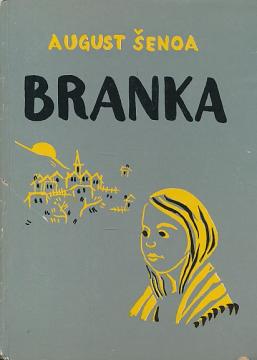
Branka

Branka

August Šenoa

Branka is a girl of middle-class origin. She lost her parents and grew up with her grandmother. She develops into a beautiful and intelligent person. She graduates from teacher training school and is full of ideals.

Branka, a teacher training graduate, faces the challenges of finding a job in a society that does not support women's ambitions. Her story begins on Vlaška Street, where she struggles with obstacles such as the resistance of her local teacher and traditional norms, but maintains her idealism and determination to become a teacher. Through the character of Branka, Šenoa explores themes of women's rights, education, and social justice. Her love story with the young Count Belizar further complicates her path to realizing her personal ambitions. The novel not only depicts the challenges women face in a patriarchal society, but also the broader social changes in Croatia in the second half of the 19th century, making it a significant work of Croatian literature.

Editor
Vladimir Kovačić
Graphics design
Ema Bursać
Dimensions
20 x 14 cm
Pages
151
Publisher
Seljačka sloga, Zagreb, 1955.
 
Latin alphabet. Hardcover.
Language: Croatian.

One copy is available

Condition:Used, excellent condition
Damages or inconvenience notice:
  • Signature of previous owner
  • Traces of patina
 

Are you interested in another book? You can search the offer using our search engine or browse books by category.

You may also be interested in these titles

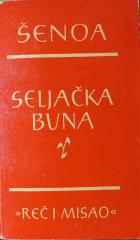
Seljačka buna

Seljačka buna

August Šenoa
Rad, 1964.
Serbian. Latin alphabet. Paperback.
2.98 - 2.99
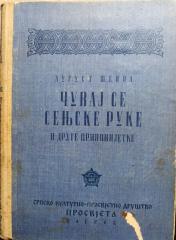
Čuvaj se Senjske ruke

Čuvaj se Senjske ruke

August Šenoa
SKD Prosvjeta, 1951.
Serbian. Cyrillic alphabet. Hardcover.
9.99
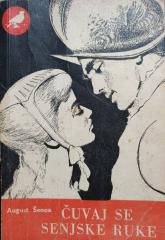
Čuvaj se Senjske ruke

Čuvaj se Senjske ruke

August Šenoa
Zora, 1962.
Croatian. Latin alphabet. Paperback.
4.88 - 4.99
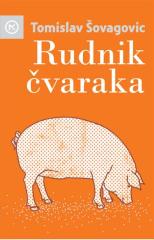
Rudnik čvaraka

Rudnik čvaraka

Tomislav Šovagović

The debut work of Croatian writer Tomislav Šovagović, awarded the Josip and Ivan Kozarac Award in 2012, is a dedication to Slavonia – the region of his childhood that the author, born in Dalmatia, observes with foreign but tender eyes.

Mozaik knjiga, 20112.
Croatian. Latin alphabet. Paperback.
11.56
Deobe 1-3

Deobe 1-3

Dobrica Ćosić

This work, awarded the NIN Prize for that year, is considered one of the most significant in Serbian literature after World War II.

Prosveta, 1961.
Serbian. Cyrillic alphabet. Hardcover with dust jacket.
The book consists of 3 volumes
11.42
Pripovetke iz levog i desnog džepa

Pripovetke iz levog i desnog džepa

Karel Čapek

These stories deal with different topics, although most deal with different criminal acts, from fraud and fortune-telling to marriage fraud and murder.

Jugoslavijapublik, 1980.
Croatian. Latin alphabet. Hardcover.
5.22