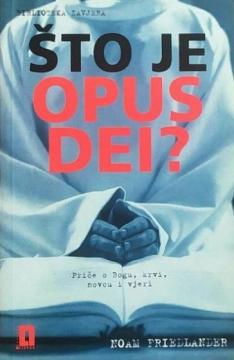
Što je Opus Dei? Priče o Bogu, krvi, novcu i vjeri
Rare book

Što je Opus Dei? Priče o Bogu, krvi, novcu i vjeri

Noam Friedlander

The Catholic movement Opus Dei, founded in 1928 in Spain as a small devout group, is today one of the most influential and richest church organizations in the world – with millions of members, a headquarters in New York worth billions, and branches across

Noam Friedlander, a British journalist and conspiracy researcher, exposes the dark side of the "Work of God" in this provocative book: from the intimate biography of its founder, Father Josemaría Escrivá - a saint canonized in 2002 - to shocking accusations of collaboration with dictators, secret services and crime. Through vivid stories, Friedlander traces Escrivá's rise: from alliance with Franco after the Spanish Civil War, through dubious ties with the Nazis during World War II, to infiltration of the Vatican and the conquest of South America and the United States.

The book examines controversial practices - self-flagellation, penances and "brainwashing" - and allegations of involvement in scandals such as banking corruption ("God's Banker" Roberto Calvi), mafia collaboration and CIA operations. Opus Dei is not just a religious sect; it is a global network of power that influences politics, finance and the church hierarchy, especially after "The Da Vinci Code" made its secrets popular.

Friedlander balances fact and legend, offering an objective look at an organization that promotes everyday holiness but hides ambitious goals. Ideal for fans of true crime, religious mysteries, and historical intrigue.

Original title
What Is Opus Dei? Tales of God, blood, money and faith
Translation
Marko Maras
Editor
Kristijan Vujičić
Dimensions
21 x 13 cm
Pages
247
Publisher
Naklada Ljevak, Zagreb, 2005.
 
Latin alphabet. Hardcover.
Language: Croatian.

One copy is available

Condition:Used, excellent condition
 

Are you interested in another book? You can search the offer using our search engine or browse books by category.

You may also be interested in these titles

Identitetske aporije

Identitetske aporije

Milorad Nikčević
Hrvatsko-crnogorsko društvo prijateljstva Croatica-Montenegrina, 2020.
Croatian. Latin alphabet. Paperback.
6.80
Snažan eho brionski: Odjeci Brionskog plenuma u Bosni i Hercegovini 1966. godine

Snažan eho brionski: Odjeci Brionskog plenuma u Bosni i Hercegovini 1966. godine

Amir Duranović

Amir Duranović's book reconstructs in detail the dramatic year 1966 and the Fourth (Brion) Session of the Central Committee of the Communist Party of Yugoslavia (July 1–2, 1966), at which Aleksandar Ranković, the long-time head of the UDB and vice preside

Udruženje za modernu historiju (UMHIS), 2017.
Croatian. Latin alphabet. Paperback.
9.54
I drugi su pjevali o ratu: Odjeci raspada Jugoslavije u engleskoj i američkoj književnosti

I drugi su pjevali o ratu: Odjeci raspada Jugoslavije u engleskoj i američkoj književnosti

Muharem Bazdulj

In this book of essays, Muharem Bazdulj analyzes how the collapse of Yugoslavia and the wars of the 1990s resonated in Anglo-Saxon literature – from pre-war stereotypes to war and post-war depictions.

Biblioteka XX vek, 2013.
Croatian. Latin alphabet. Paperback.
8.24
Sjećanja na saradnju s Alijom Izetbegovićem

Sjećanja na saradnju s Alijom Izetbegovićem

Nihad Halilbegović

Nihad Halilbegović's book is a memoir testimony of long-term professional and personal cooperation with Alija Izetbegović, the first president of independent Bosnia and Herzegovina.

Fond kantona Sarajevo, 2018.
Croatian. Latin alphabet. Hardcover.
9.98
Waging War: Conflict, Culture, and Innovation in World History

Waging War: Conflict, Culture, and Innovation in World History

Wayne E. Lee
Oxford University Press, 2015.
English. Latin alphabet. Paperback.
36.22