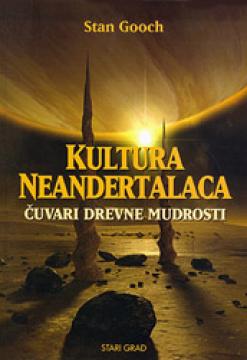
Kultura neandertalaca: Čuvari drevne mudrosti

Kultura neandertalaca: Čuvari drevne mudrosti

In this strongly documented book, the British psychologist and researcher claims that Neanderthals were the bearers of an older, more powerful, and spiritually richer culture than Cro-Magnon ("modern" man), and that it was their tradition that formed the

Many ancient beliefs and superstitions common to cultures around the world show how ideas that dominated the lives of our ancestors still have a powerful influence on us today. The disturbing power attributed to the number thirteen, the positive influence of the number seven, and even the origins of Jewish kosher laws point to the enduring presence of our oldest ancestors: the Neanderthals. Contrary to current theories, Stan Gooch argues that the younger Cro-Magnon culture did not destroy the Neanderthals, but rather that the two cultures interbred into one.

The merging of the very different influences of the lunar, matriarchal Neanderthals and the solar, patriarchal Cro-Magnons may explain the contradictory impulses and influences that have caused human conflict for millennia. In fact, the author suggests that the caste system in India may have evolved to harness the positive forces of the lunar and solar cultures and to minimize conflict between them. There is evidence that direct descendants of the Moon-worshipping and dream-loving Neanderthal race still live in Central Asia today.

Although their physical descendants may be nearly extinct, the influence of Neanderthal mystical wisdom remains strong and can be found throughout history among witches, Kabbalists, Knights Templar, Rosicrucians, and even in Christianity and Judaism.

Original title
The Dream Culture of Neanderthals
Translation
Vesna Valenčić
Editor
Božica Cikuša, Zdravko Cikuša
Graphics design
Zlatko Bilandžija
Dimensions
24 x 17 cm
Pages
250
Publisher
Stari grad, Zagreb, 2006.
 
Latin alphabet. Hardcover.
Language: Croatian.
ISBN
978-9-53671-650-0

Multiple copies are available

Copy number 1

Condition:New

Copy number 2

Condition:New

Copy number 3

Condition:New

Copy number 4

Condition:New
 

Are you interested in another book? You can search the offer using our search engine or browse books by category.

You may also be interested in these titles

Povijest #2: Egipat i antička Grčka

Povijest #2: Egipat i antička Grčka

The second volume of the History of the World edition covers the entire history of Ancient Egypt and Ancient Greece, but also the history of the ancient peoples of India, classical Chinese culture, the civilizations of the ancient Far East, ancient Africa

Europapress holding, 2007.
Croatian. Latin alphabet. Hardcover.
7.84 - 9.76
Kraj vremena: Revizija proročanstva Maya

Kraj vremena: Revizija proročanstva Maya

Adrian Gilbert

British author Adrian Gilbert (co-author of The Mayan Prophecies from 1995) in The End of Time offers the most thorough and sober modern interpretation of the Mayan calendar and the so-called "2012 prophecy", completely rejecting New Age hysteria.

Stari grad, 2009.
Croatian. Latin alphabet. Hardcover.
18.22 - 18.26
Roman mumije

Roman mumije

Theopile Gautier

To reconstruct the splendor of the Nile civilization, Théophile Gautier used all the knowledge of emerging Egyptology and gave us one of the first novels about ancient Egypt, which Europe has dreamed of since the works of Napoleon and Champollion.

Zora, 1953.
Croatian. Latin alphabet. Hardcover with dust jacket.
9.56
Nofretete: Arheološka biografija

Nofretete: Arheološka biografija

Philipp Vandenberg

The book explores the life and legacy of the Egyptian Queen Nefertiti. The book provides detailed insight into archaeological discoveries related to this enigmatic figure, known for her extraordinary beauty and influence during the 14th century BC.

Stvarnost, 1975.
Croatian. Latin alphabet. Hardcover.
7.32
Otkriće Troje

Otkriće Troje

Vojtech Zamarovsky

"The Discovery of Troy" by Vojtěch Zamarovsky is a book that describes in detail the history of the discovery of the ancient city of Troy, with special emphasis on the archaeological research of Heinrich Schliemann.

Epoha, 1964.
Croatian. Latin alphabet. Hardcover with dust jacket.
8.56