Kult amatera: kako blogovi MySpace, YouTube i ostali suvremeni mediji…

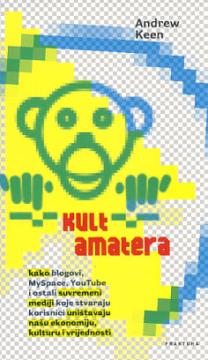
Kult amatera: kako blogovi MySpace, YouTube i ostali suvremeni mediji…

Andrew Keen

"Cult of Amateurs" will certainly encourage you to question what you take for granted and change the way you surf the internet and use Facebook, MySpace, YouTube and other services.

According to the famous infinite monkey theorem, if we let an infinite number of monkeys type on an infinite number of typewriters, somewhere, one of those monkeys would eventually create a Shakespeare play, a Plato dialogue, or some other masterpiece. With the invention of the Internet, it was thought that all this creative potential that was just waiting to burst out of ordinary users would flourish. Instead, we got superficiality, pornography, identity theft, and a new corporate paradise. In his devastating critique of the so-called Web 2.0 revolution, Andrew Keen, not without reason called the antichrist of Silicon Valley, set out to destroy this myth once and for all by showing not only that the Internet is ruled by mediocrity, but also that digital giants like Wikipedia and Google are not necessarily good players. Discover why we are about to enter Brave New World 2.0. Even if you don't agree with everything.

Original title
The cult of amateur
Translation
Ivana Krencer
Editor
Seid Serdarević
Dimensions
21 x 13.5 cm
Pages
237
Publisher
Fraktura, Zaprešić, 2010.
 
Latin alphabet. Hardcover with dust jacket.
Language: Croatian.

One copy is available

Condition:Used, excellent condition
Discounted price: 7.686.14
20% discount is valid until 7/3/26 11:59 pm
 

Are you interested in another book? You can search the offer using our search engine or browse books by category.

You may also be interested in these titles

Radikalna desnica u Republici Poljskoj: Ideologija i politika

Radikalna desnica u Republici Poljskoj: Ideologija i politika

Stjepan Lacković

The author presents the main characteristics of the radical Polish right in an analytically based and documentary manner. It is a powerful political formation that has dominated Polish politics for the past 20 years, so in 2005-2007 two radical right-wing

Plejada, 2024.
Croatian. Latin alphabet. Hardcover.
26.42
Sve što je čvrsto i postojano pretvara se u dim...

Sve što je čvrsto i postojano pretvara se u dim...

Katarina Peović-Vuković

Katarina Peović's collection of texts revives Marxism in the era of capitalist crisis. The book analyzes key works by Marx and Engels, connecting them with contemporary thinkers such as Alain Badiou and Michael Lebowitz.

Durieux, 2021.
Croatian. Latin alphabet. Paperback.
16.52
Kreativne industrije

Kreativne industrije

John Hartley

''Creative Industries'' is a bold collection of essays that charts the tumultuous revolution that is transforming the production, consumption, and understanding of culture in an era of all-connections.

Multimedia Clio, 2007.
Serbian. Latin alphabet. Hardcover.
14.9811.98
Ljudska povijest emocija: Kako su naši osjećaji sagradili svijet kakav poznajemo

Ljudska povijest emocija: Kako su naši osjećaji sagradili svijet kakav poznajemo

Richard Firth-Godbehere

In this provocative and interdisciplinary book, the author shows that emotions are not universal biological constants, but change across time, cultures, and social contexts – and they are precisely those that are crucial in shaping the history of humanity

Školska knjiga, 2023.
Croatian. Latin alphabet. Hardcover with dust jacket.
21.36
Karl Marx: Čovjek preinake svijeta

Karl Marx: Čovjek preinake svijeta

Davor Kačar, Boris Jurinić

Karl Marx - The Man Who Changed the World (1983) by Davor Kačar and Boris Jurinić is a study of the life and work of Karl Marx. It explores his philosophy, economic theory, and influence on world history through Marxism, with illustrations and documents.

Svjetlost, 1983.
Croatian. Latin alphabet. Hardcover with dust jacket.
12.24
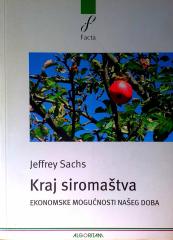
Kraj siromaštva: Ekonomske mogućnosti našeg doba

Kraj siromaštva: Ekonomske mogućnosti našeg doba

Jeffrey Sachs

In the book, economist Jeffrey Sachs presents an optimistic plan for eliminating extreme poverty by 2025. He argues that this is feasible with political will, because world wealth is growing, and poverty is not fate, but the result of inefficient systems.

Algoritam, 2007.
Croatian. Latin alphabet. Paperback.
9.78