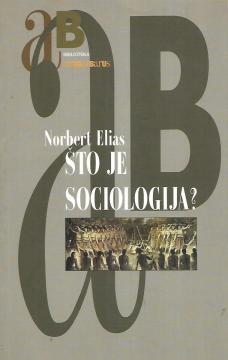
Što je sociologija?

Što je sociologija?

Norbert Elias

A classic work by one of the most influential sociologists of the 20th century, the founder of "figurative" or "process" sociology. The book is a programmatic manifesto against the then dominant structural-functionalist paradigm (Parsons) and pure positiv

Elias elaborates on his key concepts in the book:

  • “figure” (the interdependence of individuals as the basic unit of analysis, not “individual” or “society” as separate instances)
  • “process” – society is not a static state but a long-term, unintentional process (the most famous example: “civilization process”)
  • “social configuration” – a network of interdependencies that shape the behavior of individuals
  • critique of “homo clausus” – the illusion that the individual is a closed box, separated from others

Elias introduces familiar metaphors: society as a dance (four or more people dancing together – there is no dancer without a dance), a game (changing the balance of power changes the rules) and the example of two warring villages that, without intention, create an increasingly complex social structure.

A special chapter is dedicated to “game models” – simple schemes that show how monopolies of power, states and civilizations are born from interdependencies. In the Croatian context, the book has become required reading at universities, as it offers a completely different view of the wars of the 1990s: not as a conflict of "peoples" but as a process of disintegration of long-term interdependencies.

Original title
Was ist Soziologie?
Translation
Srećko Horvat
Editor
Rade Kalanj
Dimensions
24 x 15 cm
Pages
162
Publisher
Antibarbarus, Zagreb, 2007.
 
Latin alphabet. Paperback.
Language: Croatian.
ISBN
978-9-53249-046-6

One copy is available

Condition:Used, excellent condition
 

Are you interested in another book? You can search the offer using our search engine or browse books by category.

You may also be interested in these titles

Ukrajinski Karpati: Etnogeneza, arheologija, etnologija

Ukrajinski Karpati: Etnogeneza, arheologija, etnologija

The collection is an interdisciplinary bridge between Ukrainian and Croatian science, encouraging comparative research on Slavic migrations. It presents the Carpathians as a "living archipelago" connecting East and West, important for Croatian ethnogenesi

Filozofski fakultet Sveučilišta u Zagrebu, 2014.
Croatian. Latin alphabet. Paperback.
18.34
Divlja Evropa

Divlja Evropa

Božidar Jezernik

At the center of Jezernik's scientific work is ethnological and anthropological research of the Balkans and Eastern Europe.

Biblioteka XX vek, 2007.
Serbian. Latin alphabet. Paperback.
9.98
Red reči: Lingvistički ogledi, četiri

Red reči: Lingvistički ogledi, četiri

Milka Ivić

The famous Serbian linguist and one of the most influential figures in 20th-century Yugoslav linguistics, in this book continues her series of "Linguistic Reflections" – lucid, erudite essays that combine general linguistics, the Serbian language, and cul

Biblioteka XX vek, 2002.
Serbian. Latin alphabet. Paperback.
7.56
Izvješća iz Tarahumare

Izvješća iz Tarahumare

Ivan Rattkay

The book contains three Latin reports by the Croatian Jesuit, nobleman and explorer Ivan Rattkay (Ratkaj, 1647–1683), born in Ptuj (today Slovenia), sent to the provincial of the Austro-Czech Jesuit province from the mission in northern Mexico.

ArTresor naklada, 1998.
Croatian. Latin alphabet. Hardcover with dust jacket.
9.56
Politika simbola

Politika simbola

Ivan Čolović

The essays collected in this book are inspired by the idea that politics is largely a matter of symbols.

Biblioteka XX vek, 2000.
Serbian. Latin alphabet. Paperback.
9.64
Simbolizam i tumačenje

Simbolizam i tumačenje

Tzvetan Todorov

In the book, Todorov examines the relationship between the production of discourse (rhetoric) and its interpretation (hermeneutics), focusing on verbal symbolism – the phenomenon of indirect meaning that builds on direct, literal meaning.

Svetovi, 1986.
Serbian. Latin alphabet. Paperback with dust jacket.
9.54