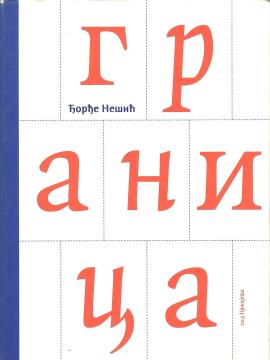
Granica

Granica

Đorđe Nešić

The collection is one of Nešić's key books from the post-war period of the 1990s, when he faced exile, minority status, and identity fractures on the border of two worlds – Croatian and Serbian, Slavonian and Danube.

The title "Border" is a multi-layered symbol: a physical border (the Danube, the state line), a border between the past and the present, life and death, memory and oblivion, and the border of humanity in war and the post-war period. The poems are intimate, melancholic, with strong homeland motifs: the Danube as an eternal river that carries memories, the villages of Bijelo Brdo and Dalj, vineyards, houses, people who stayed or left.

Nešić writes about the minority position of Serbs in Croatia – about silence, fear, loss of language and culture, but also about resistance through poetry and memory. The verses are precise, rhythmic, with a touch of lyrical minimalism and deep sadness, but without pathos – more contemplative than accusatory. The border becomes a place of encounter and separation, where identity is sought in fragments.

The collection is part of Nešić's oeuvre dedicated to homeland, gender, and language (along with "The Window Through Which the Danube Flows", "It's Better to Be in the Minority"). It is valued in Serbian literature in Croatia as a testament to the survival of culture on the edge, with an emphasis on the silent power of words as a barrier against oblivion.

Editor
Čedomir Višnjić
Dimensions
18 x 13 cm
Pages
60
Publisher
SKD Prosvjeta, Zagreb, 2006.
 
Cyrillic alphabet. Paperback with dust jacket.
Language: Serbian.

One copy is available

Condition:Used, excellent condition
 

Are you interested in another book? You can search the offer using our search engine or browse books by category.

You may also be interested in these titles

Sto pedeset godina od dolaska Jakova Ignjatovića u Dalj (1863.-2013.)

Sto pedeset godina od dolaska Jakova Ignjatovića u Dalj (1863.-2013.)

Đorđe Nešić

Proceedings of the international scientific conference held in 2013 in Dalj, on the occasion of the 150th anniversary of the arrival of the Serbian realist writer Jakov Ignjatović (1822–1889) in Dalj.

Kulturni i znanstveni centar Milutin Milanković, 2014.
Serbian. Cyrillic alphabet. Paperback.
4.98
Metamorfoze iliti pretvorbe

Metamorfoze iliti pretvorbe

Mario Kovač

The main motifs of the collection are love and everyday life, followed by poetry, and a subtle homage to Zagreb.

Što čitaš?, 2019.
Croatian. Latin alphabet. Paperback.
5.38
Muze i Erinije : Sabrane pjesme : 1977. - 2020.

Muze i Erinije : Sabrane pjesme : 1977. - 2020.

Mile Stojić

Writing in the first person singular, Stojić depicted the life and dreams, experience and fate, defeat and loss of homeland of a generation, a city, an era.

VBZ, 2021.
Croatian. Latin alphabet. Hardcover.
21.98
Sve ča mi rabi ovega prolića

Sve ča mi rabi ovega prolića

Evelin Rudan

Everything I Need This Spring is the first solo poetry collection by Evelina Rudan, a poet and scholar from Pula and Zagreb (born 1971). The book represents a significant contribution to contemporary Istrian Chakavian lyric poetry.

Naklada MD, 2000.
Croatian. Latin alphabet. Paperback.
5.32
Malo prije svega odavno smo

Malo prije svega odavno smo

Goran Rem

A Little Before Everything, Long Ago We Are is the eleventh collection of poetry by Goran Rem (b. 1958, Osijek), a poet, essayist, literary historian, and member of the Quorum generation in Croatian literature.

MeandarMedia, 2024.
Croatian. Latin alphabet. Paperback with dust jacket.
12.34
Zašto vam pišem ljubavne pjesme

Zašto vam pišem ljubavne pjesme

Marija Slavica

A collection of love poetry by Marija Slavica from Šibenik

Vlastita naklada, 2010.
Croatian. Latin alphabet. Hardcover.
7.986.38