Dobri Bošnjani: crtice, pripovijesti, novele
Good Bosnians (1937) is a collection of sketches, stories, and novellas by Alija Namek. The main historical novella depicts the life and spiritual resistance of "good Bosnians" (Christians) in medieval Bosnia, emphasizing identity, honesty, and self-fidel
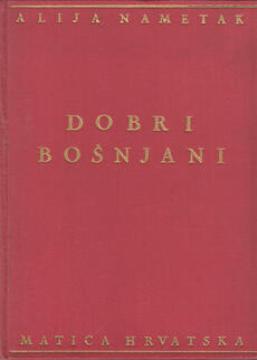
Alija Nametak (Mostar, 1906 – Sarajevo, 1987), a Bosnian-Herzegovinian storyteller, playwright and folklorist, published the collection Dobri Bošnjani: crtice, pripovijesti, novele published by Matica Hrvatska, as his second significant collection after Bajram žrtava (1931).
The book contains several shorter prose works, and the most important is the historical novella of the same name set in the 14th century – the time of Ban Stjepan II Kotromanić and King Tvrtko I. Through the fates of the Krstjani (members of the Bosnian Church), Nametak depicts everyday life in the Bosnian mountains, their spiritual strength, simplicity and moral integrity in the face of external pressures (papal envoys, Hungary, Dubrovnik) that demand Christianization and the destruction of Bosnian religious distinctiveness.
The work is a moral parable about identity, resistance and dignity. "The Good Bosnian" becomes a symbol of a man who remains true to himself despite persecution, torture, and political pressure. Nametak uses a medieval framework to affirm the historical depth and spiritual independence of Bosnians, opposing the attempts of the time to deny their uniqueness.
The style is realistic with lyrical and archaic elements, precise in the details of the Bosnian čaršija and village life, and imbued with a deep knowledge of tradition and folklore. The collection emphasizes social and moral themes: honesty, character, the conflict between tradition and modernity, and the solidarity of ordinary people.
In the context of Nametak's oeuvre, Dobri Bošnjani represents an important step in the formation of Bosniak literary consciousness in the interwar period. Today, the work is read as a significant document of cultural and national identity, and as a quality historical and moral prose of the 20th century. A rare antiquarian edition of Matica Hrvatska.
One copy is available