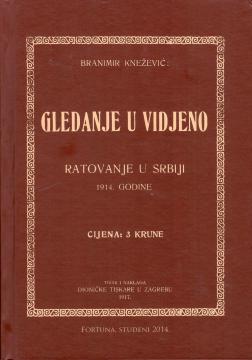
Gledanje u viđeno – ratovanje u Srbiji 1914. godine
Looking into the Past - Warfare in Serbia in 1914 is a valuable documentary-diary prose by Branimir Knežević, which includes records of warfare on the Serbian battlefield, interspersed with reflections.
Looking into the Past – Warfare in Serbia in 1914 by Branimir Knežević is a reprint of a memoir-diary book from the war period that brings the personal testimony of an Austro-Hungarian officer about the first months of the Great War on the Serbian battlefield. Instead of a cold military analysis, the author offers a series of episodes intertwined with personal impressions, emotional reactions and literary reflections, which gives the work a distinct narrative and documentary value.
Knežević first describes the formation of the 11th Infantry Regiment and the mobilization turmoil that accompanied the Monarchy's entry into the war. This is followed by an account of the journey to Serbia, the atmosphere in the units and the first contacts with the unfamiliar landscape over which battles would soon be fought. The author particularly emphasizes the arrival in the area near Šabac, where the Austro-Hungarian forces faced strong and organized Serbian resistance. The depiction of the battles is dominated by motifs of chaotic clashes, uncertainty, fatigue and constant changes in advance and retreat.
The book is centered around a series of episodes culminating in the retreat after the defeat of the Austro-Hungarian forces in the Battle of Cer. Knežević does not portray the events through strategic schemes, but through scenes from the trenches, conversations between soldiers, improvised command decisions, and the psychological states of warriors trying to understand what is happening around them. His dominantly personal tone sets the book apart from classic war reports: the war is depicted as a series of moments – confusion, fear, hope, and brief flashes of courage.
The author's literary education is of particular value. On the eve of the war, Knežević had already published a collection of sketches Mondaine romances and a novella Earth, which is evident in the dense descriptions of the setting, lively dialogues, and ability to portray traumatic scenes with literary nuance, but without losing documentary truth. The work thus functions as a blend of diary, memoir, and prose, providing an insider's view of one of the most difficult and chaotic moments of the Austro-Hungarian campaign of 1914.
Two copies are available