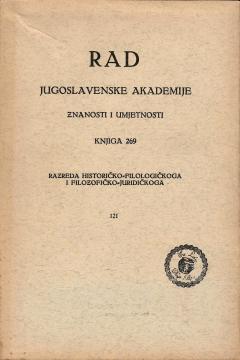
Rad JAZU: Knjiga 269 razreda historičko-filologičkoga i filozofičko-juridičkoga
The collection brings together works on political and military events of the late 18th and early 19th centuries, on church law, and on the literary and cultural interpretation of Njemač's "Kvara bez kruha".
The book 269 Works of the Yugoslav Academy of Sciences and Arts brings together the works of the historical-philological and philosophical-legal departments, which together form a broad cross-section of humanities and social research.
The first contribution, by Dr. Grgo Novak, deals with the political and social processes related to the movement for the unification of Dalmatia with Croatia in the period from the end of the 18th to the beginning of the 19th century. Novak reconstructs the changes of government, changes in administrative structures and the development of the idea of national belonging and places them in the dynamic context of European political turmoil.
The second contribution is by Aleksej A. Olesnicki, who focuses on the Bosnian army under the leadership of Bećir-paša Ćengić during the Russian-Turkish War of 1737. The author explores the military capacities, organization, the role of local commanders and the strategic challenges of the Ottoman Empire, providing insight into a complex chapter in Ottoman-European relations.
The third contribution, by Dr. Mihajlo Lalović, is dedicated to church law and its position within the system of legal sciences. Lalović analyzes the historical foundations of church law, its relationship to secular legislation and its importance for the development of legal thought, emphasizing the interdisciplinary nature of this area.
The last work, signed by Vladoje Dukat, provides a literary analysis of Nemčić's work "Kvar bez kruha". The author deals with the moral, social and cultural messages of the text, and at the heart of the interpretation is the question of authority and moral jurisprudence. Dukat's approach reveals the multi-layered nature of the literary presentation and its place in the Croatian cultural tradition.
The entire book reflects the interdisciplinary character of the Academy's work, combining history, law, military topics and literary analysis into a whole that testifies to the breadth of scientific interests and methodological diversity.
One copy is available