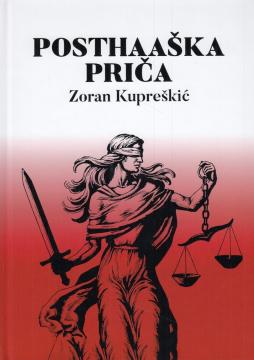
Posthaaška priča

Posthaaška priča

Zoran Kupreškić

Zoran Kupreškić's memoir "Post-Hague Story" is a sequel to "Hague Story." It brings personal testimonies about the injustice of the Hague Tribunal, life after liberation, and the fight for truth.

Post-Hague Story by Zoran Kupreškić is a memoir published some twenty years after “The Hague Story” (which saw two editions), in which the author returns to the topic of his own experience with the Hague Tribunal and life after the acquittal.

The book is structured as 24 answers to the most frequently asked questions that the brothers Zoran and Mirjan Kupreškić received from people – students, journalists, and the curious – after their return from The Hague. It covers the period from the war in central Bosnia, the indictment, their voluntary departure to The Hague, four years and 17 days spent in detention, to the acquittal by the Appeals Chamber and life after that.

Zoran Kupreškić writes openly about the injustice of the Hague prosecution, false testimonies, the media campaign, the suffering of the family, but also about the faith, perseverance, and peace with which they returned home. The book emphasizes that the brothers did not receive any satisfaction or compensation despite their complete acquittal, and that they still bear the burden of the accusation in public.

Editor
Anto Zirdum
Graphics design
Nataša Križanović
Dimensions
25 x 17 cm
Pages
223
Publisher
HKD Napredak, Vitez, 2024.
 
Latin alphabet. Hardcover.
Language: Croatian.

One copy is available

Condition:Unused
 

Are you interested in another book? You can search the offer using our search engine or browse books by category.

You may also be interested in these titles

Anđelko Mijatović: Bleiburška tragedija i križni put hrvatskoga naroda godine 1945.

Anđelko Mijatović: Bleiburška tragedija i križni put hrvatskoga naroda godine 1945.

Anđelko Mijatović

The Bleiburg Tragedy and the Way of the Cross of the Croatian People in 1945 is a historical-documentary work by Croatian historian and university professor Anđelko Mijatović.

HSK, 2007.
Croatian. Latin alphabet. Paperback.
6.62
Od Pola do Malnara: Putnici i istraživači u hrvatskoj kulturi od 13. do 20. stoljeća

Od Pola do Malnara: Putnici i istraživači u hrvatskoj kulturi od 13. do 20. stoljeća

Juraj Bubalo

The book by Zagreb travel writer and professor Juraj Bubalo is a kind of encyclopedia of Croatian travelers and explorers. Unique in Croatian non-fiction, it popularizes the culture of exploration and reminds us that Croats have been part of global discov

Meridijani, 2024.
Croatian. Latin alphabet. Hardcover.
28.32
U modi: Kultura odijevanja porečkih plemenitih građana (1650.-1720.)

U modi: Kultura odijevanja porečkih plemenitih građana (1650.-1720.)

Elena Uljančić

The book represents a novelty not only in Istrian, but also in Croatian historiography. Namely, the clothing culture in the region of Istria in the early modern period has not yet been analyzed at all, and for the region of Dalmatia only sporadically.

Srednja Europa, 2019.
Croatian. Latin alphabet. Hardcover.
16.99
Politika sporazuma: dnevničke beleške 1939-1941, londonske beleške 1944-1945

Politika sporazuma: dnevničke beleške 1939-1941, londonske beleške 1944-1945

Mihailo Konstantinović

The generation to which Konstantinović belonged managed to reach an agreement and, had it not been for the Second World War, was on the threshold of establishing liberal democracy in Yugoslavia, whose supporter Konstantinović was.

Agencija Mir, 1998.
Serbian. Latin alphabet. Hardcover.
39.99
Putovanje po Bosni

Putovanje po Bosni

Ivan Kukuljević Sakcinski

Ivan Kukuljević Sakcinski's travelogue provides a vivid account of Bosnia in the mid-19th century, recording the landscape, customs, political circumstances, and everyday life under Ottoman rule.

Fortuna d.o.o., 2007.
Croatian. Latin alphabet. Hardcover.
14.60
Izvori za hrvatsku povijest do 1526. godine

Izvori za hrvatsku povijest do 1526. godine

Nada Klaić

The work presents key narrative and diplomatic sources for Croatian history up to 1526, with a critical analysis of their reliability, context, and interconnections, and emphasizes the development of Croatian political structures throughout the Middle Age

Fortuna d.o.o., 2019.
Croatian. Latin alphabet. Hardcover.
22.56