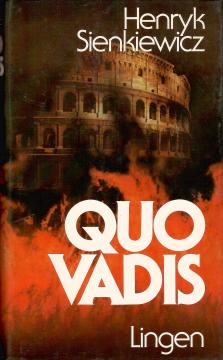
Quo vadis?

Quo vadis?

Henryk Sienkiewicz

The novel Quo Vadis depicts the love between the Roman patrician Marcus Vinicius and the Christian Lygia during the reign of Emperor Nero, and the conflict between the cruelty of the Roman Empire and Christian values.

Quo vadis? by Henryk Sienkiewicz is a historical novel set in Rome during the reign of Emperor Nero. The main character is a young Roman patrician Marcus Vinicius who falls in love with Lygia, a girl raised in the Christian faith. To win her over, he initially uses his position and power, but gradually changes under the influence of her kindness and Christian principles. Petronius, Vinicius' uncle, known for his intelligence, sophistication, and critical attitude towards the emperor's court, also plays an important role. Opposite him stands the cruel emperor Nero, whose vanity and desire for glory lead to the persecution of Christians after the Great Fire of Rome.

The novel faithfully depicts the luxury and moral decline of Roman society and contrasts violence, arrogance, and political intrigue with faith, love, and forgiveness. The scenes of the persecution of Christians in the arena are particularly impressive, where many would rather accept death than renounce their beliefs. Vinicius eventually completely changes his outlook on life and, together with Lygia, finds happiness in a new faith.

Through their fates, Sienkiewicz shows how love, faith, and sacrifice can overcome hatred and violence. The German translation retains the rich description of the historical setting and convincingly conveys the drama of the plot and the development of the main characters.

Translation
Paul Seliger
Dimensions
21 x 13 cm
Pages
471
Publisher
Helmut Lingen Verlag, Köln, 1977.
 
Latin alphabet. Hardcover with dust jacket.
Language: German.

One copy is available

Condition:Unused
 

Are you interested in another book? You can search the offer using our search engine or browse books by category.

You may also be interested in these titles

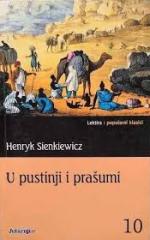
U pustinji i prašumi

U pustinji i prašumi

Henryk Sienkiewicz

Staś Tarkowski and little Nel Rawlinson are kidnapped during the Mahdi's rebellion in Africa. The children flee through the Sahara Desert and the rainforest, facing danger, hunger, and wild animals.

Jutarnji list, 2004.
Croatian. Latin alphabet. Paperback.
4.82 - 5.26
Mirza

Mirza

Henryk Sienkiewicz
Mlado pokolenje, 1967.
Serbian. Latin alphabet. Hardcover with dust jacket.
3.98 - 3.99
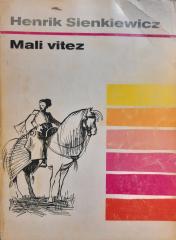
Mali vitez

Mali vitez

Henryk Sienkiewicz
Mladinska knjiga, 1974.
Slovenian. Latin alphabet. Paperback.
3.84
Start Edmunda Sulime

Start Edmunda Sulime

Zygmunt Nowakowski

The novel follows the young Edmund Sulima, who, in interwar Poland full of ideals, enters the world of theater and art, facing the difficulties of theatrical life, social intrigues, loves, and disappointments.

Savremena biblioteka, 1939.
Croatian. Latin alphabet. Hardcover with dust jacket.
9.56
Devet

Devet

Andrzej Stasiuk

“Nine” (1999) by Andrzej Stasiuk, one of the most important contemporary Polish writers, is an unusual thriller that follows a small shopkeeper, Paweł, a modern-day Ulysses, whose life changes abruptly when debt collectors rob him and destroy his apartmen

Fraktura, 2003.
Croatian. Latin alphabet. Paperback.
5.74
Sanjar

Sanjar

Wladyslaw St. Reymont

The novel The Dreamer by Polish Nobel laureate Władysław Stanisław Reymont, published in Croatian in 1944, is an introspective and philosophically tinged work that differs from his more famous realistic novels such as The Peasant.

Suvremena biblioteka, 1944.
Croatian. Latin alphabet. Hardcover.
6.224.67