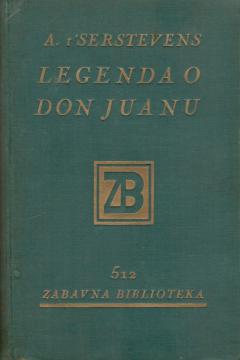
Legenda o Don Juanu
In *The Legend of Don Juan*, Albert t’Serstevens reshapes the famous legend of the tireless seducer, tracing his amorous adventures, transgressions, and conflict with the moral and social order.
The Legend of Don Juan by the Belgian-French writer Albert t’Serstevens is a literary adaptation of one of Europe’s most famous legends—the story of Don Juan, a seducer who tirelessly pursues new romantic conquests. While drawing upon traditional elements of the legend, the author weaves them into a cohesive novelistic narrative and focuses on the psychology of the protagonist.
Don Juan is portrayed as a man driven by passion, a desire for conquest, and a need for absolute personal freedom. His relationships with women are not merely a series of romantic adventures; they also reveal his attitude toward social conventions, morality, and responsibility. Thus, his life as a seducer gradually takes on a more serious significance, as the allure of adventure is shadowed by the consequences of his actions.
t’Serstevens incorporates motifs familiar from the centuries-old Don Juan tradition: romantic conquests, conflicts, transgressions, the challenging of social and moral norms, and the inevitable confrontation with the consequences of his own behavior. In doing so, he avoids portraying the hero merely as a superficial womanizer, seeking instead to delve into the character and inner motivations of the legendary seducer.
The work thus blends a tale of adventure and romance with a psychological portrait of a man who refuses to accept limitations. The author’s adaptation illustrates why Don Juan has become an enduring literary symbol of seduction, rebellion, passion, and the conflict between personal freedom and moral responsibility.
One copy is available