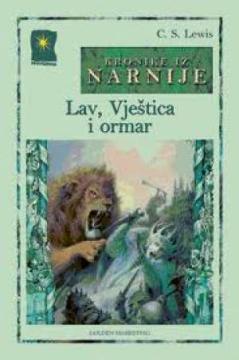
Kronike iz Narnije II: Lav, Vještica i ormar
Rare book

Kronike iz Narnije II: Lav, Vještica i ormar

C. S. Lewis

Once upon a time there were four children, named Peter, Susan, Edmund and Lucy. This is a story about something that happened to them when they were sent away from London during the war because of air raids.

Four children – Peter, Susan, Edmund and Lucy Pevensie – are sent from London to the countryside to the house of an old professor Kirk during World War II to escape bombing. Inside the house, they discover a large old wardrobe. Lucy, the youngest, enters it and finds herself in the snowy, eternally winter land of Narnia. There she meets the faun Mr. Tumus, who is friendly but works for the White Witch.

The White Witch (Jadis) has ruled Narnia for a hundred years, with the spell of eternal winter without Christmas, and turns anyone who opposes her to stone. Edmund, greedy and bitter, meets the Witch and agrees to serve her in exchange for Turkish delight and the promise of becoming King of Narnia.

Lucy tells her siblings about Narnia, but they do not believe her because Edmund is lying. Later, all four enter the wardrobe and escape to Narnia from the Witch's agents. They meet Mr. and Mrs. Beaver, who lead them to Aslan – the great lion, the true king of Narnia, who has returned to break the Witch’s power. Aslan represents Christ: powerful, good, but also dangerous.

Edmund flees from the Witch, but Aslan saves him and sacrifices himself in his place on the Stone Table – because Edmund is a traitor, and an “older spell” demands the blood of a traitor. The Witch thinks she has won, but Aslan is resurrected (because an “even deeper spell” says that an innocent person who voluntarily sacrifices himself can be resurrected). Aslan and his army (animals, fauns, centaurs) defeat the Witch in a great battle.

Four children become kings and queens of Narnia: Peter the Great, Susanna the Gentle, Edmund the Just, and Lucy the Brave. They rule long and wisely, but one day, while hunting a white deer, they find the wardrobe again and return to their world – children, but changed by the experience.

The story is an allegory of Christian salvation: sin, betrayal, sacrifice, resurrection, the triumph of good. Lewis wrote a work for children, but with a deep theological layer.

Original title
The Chronicles of Narnia: The Lion, the Witch and the Wardrobe
Translation
Sanja Lovrenčić
Editor
Anita Peti-Statnić
Illustrations
Pauline Baynes
Dimensions
21 x 15 cm
Pages
173
Publisher
Golden marketing, Zagreb, 2002.
 
Latin alphabet. Hardcover.
Language: Croatian.

One copy is available

Condition:Unused
 

Are you interested in another book? You can search the offer using our search engine or browse books by category.

You may also be interested in these titles

Kronike iz Narnije IV: Kraljević Kaspijan

Kronike iz Narnije IV: Kraljević Kaspijan

C. S. Lewis

Times are tough in Narnia, which is engulfed in civil war. Prince Caspian is forced to send a call for help to the heroes who have already proven themselves in Narnia - Peter, Susan, Edmund and Lucy. They must dethrone Caspian's uncle, King Miraz.

Golden marketing, 2002.
Croatian. Latin alphabet. Hardcover.
12.38
Kronike iz Narnije I: Čarobnjakov nećak

Kronike iz Narnije I: Čarobnjakov nećak

C. S. Lewis

The first part of the Chronicles of Narnia series. C. S. Lewis told the story as a myth of creation, temptation (like Eden), sin, redemption, and the beginnings of Narnia – an allegory of Genesis, the Fall, and God's providence.

Golden marketing, 2001.
Croatian. Latin alphabet. Hardcover.
12.36
Kardinal Alojzije Stepinac

Kardinal Alojzije Stepinac

M. Landercy, Vladimir Horvat

One might think that with this book he wants to defend Cardinal Alojzije Stepinac. No, not at all! No one and no book needs to defend him.

Župni ured, 1989.
Croatian. Latin alphabet. Paperback.
10.26
Kršćanstvo prije Krista?

Kršćanstvo prije Krista?

Eugen Werber

"Qumran writings" or "Dead Sea Scrolls" represent one of the greatest discoveries of the 20th century, which lead to the revision of some overly simplified atheistic understandings.

Liber, 1972.
Croatian. Latin alphabet. Hardcover with dust jacket.
12.36
Raspeto katoličanstvo

Raspeto katoličanstvo

Boris Vušković, Srđan Vrcan
Naše teme, 1980.
Croatian. Latin alphabet. Paperback.
6.995.24
Snaga kršćanske ludosti

Snaga kršćanske ludosti

Tatjana Goričeva

The book is powerful, personal, and provocative; it is a blend of philosophy, testimony, and spiritual literature.

Karitativni fond UPT, 1986.
Croatian. Latin alphabet. Paperback.
3.62