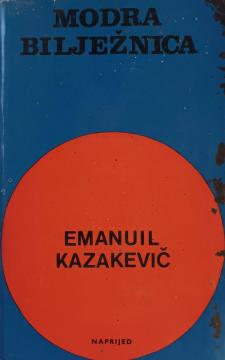
Modra bilježnica

Modra bilježnica

Emanuil Kazakevič

The novel depicts the last days of Vladimir Ilyich Lenin on the eve of the October Revolution. Through his thoughts and actions, it depicts the struggle for social change.

The novel Blue Notebook by Emanuil Kazakevich depicts the period before the October Revolution of 1917 and focuses on the character of Vladimir Ilyich Lenin during his stay in hiding in Finland. Lenin hides from the tsarist government, but at the same time he thinks intensively about the political situation in Russia and prepares plans for a revolutionary upheaval.

The central part of the novel depicts Lenin's daily life in exile: conversations with revolutionary collaborators, studying political events and writing notes that will help him shape future decisions. The title of the work is related to the blue notebook in which Lenin writes down his thoughts, ideas and conclusions about social changes.

Kazakevich portrays Lenin as a determined, educated and persistent leader who believes in the necessity of revolution. Through his conversations with other characters, the author shows the conflicts within the revolutionary movement, different opinions on the way of fighting and the uncertainty of the time when the future of Russia is being decided.

The novel combines historical events and literary treatment, emphasizing the role of the individual in major social changes. The main themes of the work are revolution, political struggle, the responsibility of the leader, and the relationship between personal beliefs and historical circumstances. Kazakevich depicts the moment before a great upheaval, when old social structures are crumbling and a new ideology is trying to find its way.

Original title
Синяя тетрадь
Translation
Milenko Popović
Editor
Aleksandar Flaker
Graphics design
Boris Dogan
Dimensions
20.5 x 13 cm
Pages
139
Publisher
Naprijed, Zagreb, 1967.
 
Latin alphabet. Hardcover with dust jacket.
Language: Croatian.

Two copies are available

Copy number 1

Condition:Used, excellent condition

Copy number 2

Condition:Used, very good condition
Damages or inconvenience notice:
  • Slight damage to the dust jacket
 

Are you interested in another book? You can search the offer using our search engine or browse books by category.

You may also be interested in these titles

Zaboravite da ste imali kćer

Zaboravite da ste imali kćer

Sandra Gregory, Michael Tierney

Sandra Gregory lived a life in Bangkok that one could only dream of until illness, unemployment and political unrest turned it into a nightmare.

Marjan tisak, 2003.
Croatian. Latin alphabet. Paperback.
7.82 - 7.98
Briefe an Milena

Briefe an Milena

Franz Kafka

Briefe an Milena brings together Kafka's letters to Milena Jesenska, born of an intense spiritual and emotional closeness. The book reveals a love imbued with longing, fear, illness, and the impossibility of living together.

Fischer Bücherei / Fischer Taschenbuch Verlag, 1966.
German. Latin alphabet. Paperback.
2.00
Love, Africa: A Memoir of Romance, War, and Survival

Love, Africa: A Memoir of Romance, War, and Survival

Jeffrey Gettleman

From Jeffrey Gettleman, a Pulitzer Prize-winning New York Times journalist, comes a passionate, revealing story about finding love and finding a calling, set against one of the most turbulent regions in the world.

HarperCollins Publishers, 2017.
English. Latin alphabet. Hardcover with dust jacket.
17.3412.14
Gruppenbild mit Dame

Gruppenbild mit Dame

Heinrich Böll

The novel reconstructs the life of Leni Pfeiffer through testimonies and documents. Leni survives Nazism, war and the post-war period, falls in love with a Soviet prisoner and remains true to her humanity despite everything.

Bertelsmann Lesering, 1977.
German. Latin alphabet. Hardcover with dust jacket.
6.74
Suha giljotina: Život kažnjenika u Gvajani

Suha giljotina: Život kažnjenika u Gvajani

Rene Belbenoit
Naprijed, 1965.
Croatian. Latin alphabet. Hardcover with dust jacket.
11.32
Pisma Cosimu I. Mediciju 1566.

Pisma Cosimu I. Mediciju 1566.

Marin Držić

Držić's letters to Cosimo I de' Medici represent a significant document of Croatian Renaissance literature and history. Držić sent three letters to Cosimo I, Grand Duke of Tuscany, between June and August 1566, while he was staying in Florence.

Croatian P.E.N. Centre & Most / The Bridge, 1993.
Croatian. Latin alphabet. Paperback.
8.32