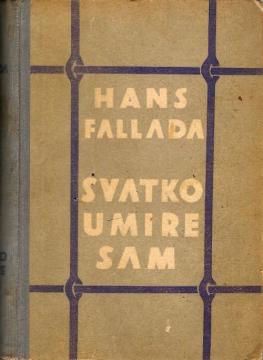
Svatko umire sam

Svatko umire sam

Hans Fallada
Original title
Jeder stribt für sich allein
Translation
Vlatko Šarić
Editor
Novak Simić
Graphics design
Edo Murtić
Dimensions
20.5 x 15 cm
Pages
627
Publisher
Zora, Zagreb, 1950.
 
Distribution: 8,000 copies
 
Latin alphabet. Hardcover.
Language: Croatian.

One copy is available

Condition:Used, excellent condition
 

Are you interested in another book? You can search the offer using our search engine or browse books by category.

You may also be interested in these titles

Razbojnici / Spletka i ljubav

Razbojnici / Spletka i ljubav

Friedrich Schiller

Two brothers, torn apart by the machinations of a younger, corrupt and deceitful creature, is a theme that is already familiar in the foundations of many literary works.

Svjetlost, 1966.
Croatian. Latin alphabet. Hardcover.
2.24
U Kordiljerima

U Kordiljerima

Karl May

In the Cordilleras (1894) is an adventure novel, a sequel to On the Rio de la Plata, part of May's South American cycle. The book follows adventures in Argentina during the revolutions, emphasizing themes of justice, forgiveness, and the struggle with the

Stvarnost, 1966.
Croatian. Latin alphabet. Hardcover.
4.52 - 7.32
Fabian: Pripovijest o moralistu

Fabian: Pripovijest o moralistu

Erich Kästner

Jakob Fabian, an unemployed Germanist and moralist, wanders through Berlin in the 1930s, observing the moral, political and social decay and the rise of Nazism. He falls in love with Cornelia, but tragedies and nonsense lead him to a tragic end. Criticism

Mladost, 1952.
Croatian. Latin alphabet. Paperback.
5.32
I ne reče ni reči

I ne reče ni reči

Heinrich Böll

In Boll's novels, one of the central themes is the attempt to preserve basic moral values ​​in a time of terror, as well as in a period of material prosperity and corruption.

Svjetlost, 1965.
Serbian. Latin alphabet. Paperback.
3.22 - 3.98
Poezija i zbilja

Poezija i zbilja

Johann Wolfgang Goethe

Goethe's greatest autobiographical prose, written between 1811 and 1833, covers his life from his birth in 1749 in Frankfurt to 1775, when he went to Weimar at the invitation of Duke Karl August.

Matica hrvatska, 1953.
Croatian. Latin alphabet. Hardcover with dust jacket.
18.42
Dnevnici, 1. svezak: 1909-1912.

Dnevnici, 1. svezak: 1909-1912.

Franz Kafka

Kafka's diaries, published posthumously, reveal the inner world of an anxious genius. The first volume covers his early years, when Kafka worked as an insurance clerk in Prague, faced with a dreary life and literary ambitions.

Tim press, 2022.
Croatian. Latin alphabet. Paperback.
15.42