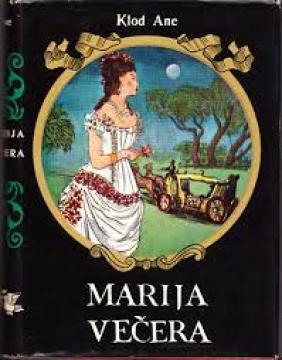
Marija Večera

Marija Večera

Claude Anet

The novel Maria Vecera (1930) is a historical story based on the tragic love affair between the Austrian Crown Prince Rudolf and Baroness Maria Vecera, culminating in their deaths in 1889 at Mayerling Castle.

Set in Vienna in the 1880s, the novel follows Rudolf, the thirty-year-old heir to the Habsburg dynasty, as he struggles with a loveless marriage, the political pressures of his father, Emperor Franz Joseph, and his own ideals of freedom.

In his search for meaning, Rudolf meets seventeen-year-old Maria, a captivating and passionate girl, and their love quickly becomes an obsession. The novel explores their inner conflicts, the social norms that constrain them, and the impossibility of escaping their fate. Annette combines historical fact with a romantic style, creating an atmosphere of intrigue and tragic inevitability.

Their deaths, portrayed as a possible murder-suicide, remain shrouded in mystery, and the court covers up the events. Annette’s portrayal of Mayerling emphasizes the passion, the conflict between duty and desire, and the tragic fate of the two lovers, making the novel a powerful portrayal of love and sacrifice in a historical context.

Original title
Mayerling
Translation
Mirjana Smolica
Graphics design
Boris Dogan
Dimensions
19 x 14 cm
Pages
234
Publisher
Progres, Novi Sad, 1966.
 
Latin alphabet. Hardcover with dust jacket.
Language: Serbian.

Two copies are available

Copy number 1

Condition:Used, excellent condition

Copy number 2

Condition:Used, very good condition
Damages or inconvenience notice:
  • The cover is missing
 

Are you interested in another book? You can search the offer using our search engine or browse books by category.

You may also be interested in these titles

Zagrepčanka

Zagrepčanka

Branislav Glumac

Branislav Glumac published a novel without periods or commas in 1974, as the relentless stream of thought of a young rebel. Published in socialist Yugoslavia, the work caused a scandal with its openness and became a classic about generational rebellion.

IROS, 1986.
Croatian. Latin alphabet. Hardcover.
8.24
Ljubičice u srijedu

Ljubičice u srijedu

Andre Maurois

André Maurois, a French writer known for his psychological novels and biographies, explores themes of family relationships, love, and internal conflicts in this work, which is characteristic of his style.

Svjetlost, 1965.
Croatian. Latin alphabet. Paperback.
3.42 - 3.62
Deobe 1-3

Deobe 1-3

Dobrica Ćosić

This work, awarded the NIN Prize for that year, is considered one of the most significant in Serbian literature after World War II.

Prosveta, 1961.
Serbian. Cyrillic alphabet. Hardcover with dust jacket.
The book consists of 3 volumes
11.42
Proces

Proces

Franz Kafka

Kafka wrote The Process between 1914 and 1915, published posthumously in 1925. The novel is unfinished but with an added final chapter by Max Brod. Edition with a foreword by B. Živojinović and an afterword by Walter Killi.

BIGZ, 1990.
Serbian. Latin alphabet. Paperback.
4.26
I ne reče ni reči

I ne reče ni reči

Heinrich Böll

In Boll's novels, one of the central themes is the attempt to preserve basic moral values ​​in a time of terror, as well as in a period of material prosperity and corruption.

Svjetlost, 1965.
Serbian. Latin alphabet. Paperback.
3.22 - 3.98
Shannonov put

Shannonov put

Archibald Joseph Cronin

Cronin's moving story of redemption. Robert Shannon, a fanatical doctor-researcher, sacrifices love and life for science, but in the end loses everything – his girlfriend, recognition, health – only to realize through suffering: medicine without humanity

Otokar Keršovani, 1966.
Croatian. Latin alphabet. Hardcover with dust jacket.
6.24