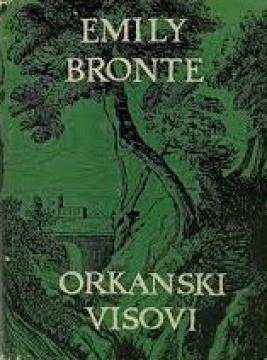
Orkanski visovi

Orkanski visovi

Emily Bronte

A first-class "sweetheart" and an unquestionable classic - this is the generally accepted perception of the reading public and critics of the famous novel by Emily Brontë from 1847, which, with its special quality and popularity, significantly surpasses t

Wuthering Heights is a relatively early outgrowth of Victorian literature and a relatively late reflection of the so-called of the Gothic tradition, so the surroundings are somewhat "darker", but nevertheless, the almost supernatural glow of love shines through it, which, despite everything, even death, lives forever. This book, it seems, will live forever, mostly because of the intense and hitherto unconceived emotional drama that Emily Brontë described unusually powerfully and convincingly. It is interesting that the novel with such a "hurricane" dramatic charge and complex psychological characterization of the characters - first of all, the demonic nature of the main character Heathcliff, who expresses an unprecedented force of anger, rage and depravity - was written by a girl of less than thirty summers, who will end her short life just after completing his only work. Thus, the fragile health of the girl left behind an immortal book that "vampirically" comes to life every now and then through numerous new editions, adaptations, reinterpretations or quotations in film, comics, music, literature... - let's remember Bunuel's treatment in the film Abyss of Passion from 1954, or the more hyped of Kate Bush's musical "reading" in the 1978 hit Wuthering Heights, while younger readers are rediscovering her through Stephenie Meyer's hyper-popular Twilight series.

Original title
Wuthering heights
Translation
Živojin Simić
Graphics design
Boris Dogan
Dimensions
20.2 x 14.5 cm
Pages
328
Publisher
Naprijed, Zagreb, 1962.
 
Latin alphabet. Hardcover with dust jacket.
Language: Croatian.

No copies available

The last copy was sold recently.
 

Are you interested in another book? You can search the offer using our search engine or browse books by category.

You may also be interested in these titles

Stotina godina (antikronika)

Stotina godina (antikronika)

Dario Harjaček

The novel One Hundred Years by Dario Harjaček provides a panoramic view of Trešnjevka and its inhabitants through a century of changes, ideologies, and human destinies – a mosaic of Zagreb in which life, art, and history intertwine.

Oceanmore, 2025.
Croatian. Latin alphabet. Paperback.
13.42
Deobe 1-3

Deobe 1-3

Dobrica Ćosić

This work, awarded the NIN Prize for that year, is considered one of the most significant in Serbian literature after World War II.

Prosveta, 1961.
Serbian. Cyrillic alphabet. Hardcover with dust jacket.
The book consists of 3 volumes
11.42
Kreutzerova sonata, Hadži-Murat

Kreutzerova sonata, Hadži-Murat

Lav Nikolajevič Tolstoj

Kreutzer's sonata belongs to those works of Tolstoy that the writer adapted in many ways to his view on moral issues, on marital morality above all.

Civitas, 2004.
Croatian. Latin alphabet. Paperback.
4.98
Rudnik čvaraka

Rudnik čvaraka

Tomislav Šovagović

The debut work of Croatian writer Tomislav Šovagović, awarded the Josip and Ivan Kozarac Award in 2012, is a dedication to Slavonia – the region of his childhood that the author, born in Dalmatia, observes with foreign but tender eyes.

Mozaik knjiga, 20112.
Croatian. Latin alphabet. Paperback.
11.56
Usta puna zemlje

Usta puna zemlje

Branimir Šćepanović

The novel "Usta puna zemlje" (1970), the masterpiece of the Serbian writer Branimir Šćepanović, is a psychologically in-depth explorer of the limits of the human soul, solitude and existential freedom, reminiscent of Kafka and Camus.

BIGZ, 1987.
Serbian. Latin alphabet. Paperback.
3.98
Krčma

Krčma

Julian Stryjkowski

The book "Inn" by Julian Stryjkowski, published in 1977, explores life in a small Jewish village in Galicia during the 19th century.

BIGZ, 1977.
Serbian. Latin alphabet. Paperback.
4.38