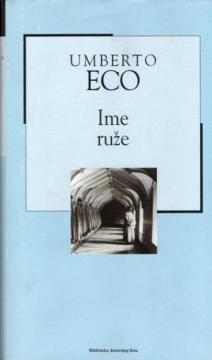
Ime ruže

Ime ruže

Umberto Eco

Eco's philosophical-religious-criminological novel The Name of the Rose was immediately recognized as an exceptional work, so it became - and remains - a book that is read and talked about all over the world.

The story is told from the perspective of Adso of Melk, a young monk who accompanies the Sherlock Holmes-inspired Franciscan William of Baskerville to a monastery where they investigate a series of mysterious deaths. The monastery, a center of learning and culture, houses a valuable library, but also hides dark secrets. The deaths of the monks are linked to a mysterious book – Aristotle’s treatise on comedy – which provokes conflicts between the monks, the Inquisition and the church authorities.

William’s rational approach to research clashes with fanaticism and dogmatic attitudes, especially with the figure of Bernardo Gui, the inquisitor. Through complex dialogues, Eco discusses the conflict between reason and faith, freedom of thought and authority. The labyrinthine library symbolizes the search for knowledge, but also the danger of its suppression. The novel culminates in a tragic denouement, where the truth comes to light, but at great cost.

Eco masterfully combines erudition, suspense, and humor, creating a novel that is both an exciting mystery and a profound meditation on the human need for meaning.

Original title
Il nome della Rosa
Translation
Morana Čale
Dimensions
21 x 12.5 cm
Pages
506
Publisher
Jutarnji list, Zagreb, 2004.
 
Latin alphabet. Hardcover with dust jacket.
Language: Croatian.
ISBN
978-9-53716-000-5

No copies available

The last copy was sold recently.


Are you interested in another book? You can search the offer using our search engine or browse books by category.

You may also be interested in these titles

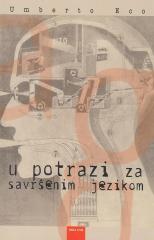
U potrazi za savršenim jezikom

U potrazi za savršenim jezikom

Umberto Eco
Hena Com, 2004.
Croatian. Latin alphabet. Hardcover with dust jacket.
17.26 - 17.36
Trag divljači

Trag divljači

Karl Bruckner
Otokar Keršovani, 1961.
Croatian. Latin alphabet. Paperback.
5.303.71
Prognanik

Prognanik

Vance Bourjaily
Zora, 1963.
Croatian. Latin alphabet. Hardcover with dust jacket.
9.99
Kapetanova kći

Kapetanova kći

Aleksandar Sergejevič Puškin
Branko Đonović, 1963.
Serbian. Latin alphabet. Hardcover.
4.62
Bijelo ciganče

Bijelo ciganče

Vidoe Podgorec

The story of a boy named Tarun, who lost his parents during the war after they were killed by the Nazis. He was left by the side of the road, where he was found by wandering Roma who decided to adopt him. Because of his fair skin, they called him "White G

Mladost, 1987.
Croatian. Latin alphabet. Paperback.
3.56 - 3.74
Čiča Goriot

Čiča Goriot

Honore de Balzac

Uncle Goriot is the story of the old war profiteer Goriot and his daughters, who, after robbing him to the skin, leave him to die in the solitude and misery of the Vaquer boarding house, a story that can be read today on several levels.

Kultura, 1957.
Croatian. Latin alphabet. Hardcover with dust jacket.
4.82