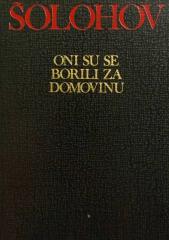
Oni su se borili za domovinu

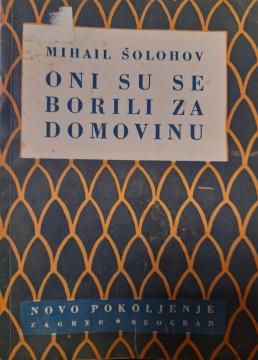
Oni su se borili za domovinu

Mihail Šolohov
Editor
Jure Kaštelan, Živko Jeličić
Dimensions
17 x 12 cm
Pages
59
Publisher
Novo pokoljenje, Zagreb, 1947.
 
Latin alphabet. Paperback.
Language: Croatian.

One copy is available

Condition:Used, very good condition
 

Are you interested in another book? You can search the offer using our search engine or browse books by category.

You may also be interested in these titles

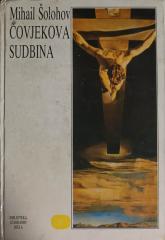
Čovjekova sudbina

Čovjekova sudbina

Mihail Šolohov
Svjetlost, 1988.
Croatian. Latin alphabet. Hardcover.
4.99
Oni su se borili za domovinu

Oni su se borili za domovinu

Mihail Šolohov

Mikhail Sholokhov is a famous Russian writer, and his collected works include some of the most important literary achievements.

Svjetlost, 1979.
Croatian. Latin alphabet. Hardcover.
4.86
Edda Gylfaginning / Obmanjivanje Gylfija

Edda Gylfaginning / Obmanjivanje Gylfija

Snorri Sturluson

Within medieval European literature, Snorra Edda occupies a particularly significant position, as it represents the only attempt at a systematic presentation of mythological tradition on our continent.

ArTresor naklada, 1997.
Croatian. Latin alphabet. Paperback.
9.28
Stotina godina (antikronika)

Stotina godina (antikronika)

Dario Harjaček

The novel One Hundred Years by Dario Harjaček provides a panoramic view of Trešnjevka and its inhabitants through a century of changes, ideologies, and human destinies – a mosaic of Zagreb in which life, art, and history intertwine.

Oceanmore, 2025.
Croatian. Latin alphabet. Paperback.
13.42
Koncert za tequilu i apaurin

Koncert za tequilu i apaurin

Edo Popović

A short novel by Edo Popović, one of the most important Croatian prose writers of the 1990s and 2000s. The book is part of Popović's "Zagreb Cycle" – a critique of transition without pathos, but through absurdity and grotesqueness.

Meandar, 2003.
Croatian. Latin alphabet. Paperback.
3.26
Čiča Goriot

Čiča Goriot

Honore de Balzac

Uncle Goriot is one of the most famous and important novels by Honoré de Balzac, published in 1835. It is part of his vast cycle The Human Comedy (La Comédie humaine), and is considered perhaps the most successful work in that cycle.

Školska knjiga, 1974.
Croatian. Latin alphabet. Paperback.
4.36