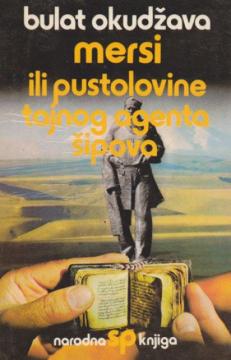
Mersi, ili Pustolovine tajnog agenta Šipova

Mersi, ili Pustolovine tajnog agenta Šipova

Bulat Okudžava
Original title
Mersi, ili Pohodženija Šipova
Translation
Biljana Paunović-Čudomirović
Graphics design
Zoran Branković
Dimensions
20 x 13 cm
Pages
242
Publisher
Narodna knjiga, Beograd, 1983.
 
Distribution: 5,000 copies
 
Latin alphabet. Paperback with dust jacket.
Language: Serbian.

One copy is available

Condition:Used, excellent condition
Damages or inconvenience notice:
  • Traces of patina
 

Are you interested in another book? You can search the offer using our search engine or browse books by category.

You may also be interested in these titles

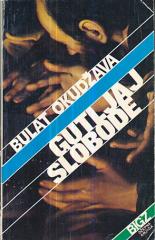
Gutljaj slobode

Gutljaj slobode

Bulat Okudžava
BIGZ, 1979.
Serbian. Latin alphabet. Paperback.
3.99
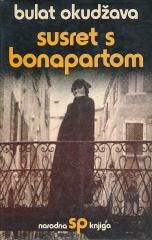
Susret s Bonapartom

Susret s Bonapartom

Bulat Okudžava

Bulat Okudžava often called his historical novel Meeting with Bonaparte his best work.

Narodna knjiga, 1988.
Serbian. Latin alphabet. Paperback with dust jacket.
7.465.97
Prolećne vode

Prolećne vode

Ivan Sergejevič Turgenjev

During his stay in Mainz, the young Russian nobleman Sanjin meets the beautiful Italian Gemma, with whom he falls in love.

Svjetlost, 1963.
Croatian. Latin alphabet. Paperback.
3.26 - 4.12
Leopard sa Kilimandžara

Leopard sa Kilimandžara

Olga Larionova

Leopard from Kilimanjaro Set in the not-too-distant future, the plot of the novel tells about the fate of man, faced with the unfathomable questions of death and love.

Jugoslavija, 1978.
Serbian. Latin alphabet. Paperback.
4.50
Lovčevi zapisi

Lovčevi zapisi

Ivan Sergejevič Turgenjev

A collection of 18 short stories (originally 25) by the famous Russian writer Ivan S. Turgenev, published in 1852. The work arose from his experiences as a passionate hunter, and the stories were written during the 1840s and published in the magazine "Sov

Školska knjiga, 1974.
Croatian. Latin alphabet. Paperback.
5.26
Mrtve duše

Mrtve duše

Nikolaj Vasiljevič Gogolj

Dead Souls (1842) is a brilliant satire that exposes the moral and social rot of imperial Russia through Chichikov's fraud with dead serfs, with Gogol's virtuoso mix of humor, irony and lyricism.

Veselin Masleša, 1969.
Croatian. Latin alphabet. Hardcover with dust jacket.
6.98