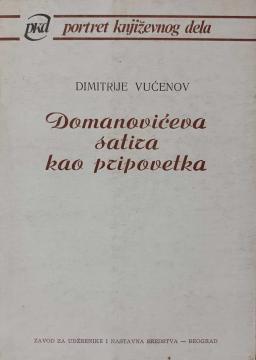
Domanovićeva satira kao pripovetka

Domanovićeva satira kao pripovetka

Dimitrije Vučenov
Graphics design
Mirko Marković
Dimensions
20 x 14.3 cm
Pages
135
Publisher
Zavod za udžbenike i nastavna sredstva, Beograd, 1983.
 
Distribution: 8,000 copies
 
Latin alphabet. Paperback.
Language: Serbian.

One copy is available

Condition:Used, very good condition
 

Are you interested in another book? You can search the offer using our search engine or browse books by category.

You may also be interested in these titles

Gradić gdje je vrijeme stalo

Gradić gdje je vrijeme stalo

Bohumil Hrabal

Bohumil Hrabal, a Czech writer known for his lyrical grotesque and humor, in his novel The Town Where Time Stood Still evokes childhood in the small town of Libeň (part of Prague), where time seems to stand still in a magical but melancholic world.

Hena Com, 2006.
Croatian. Latin alphabet. Paperback.
7.625.72
Duhovitost duhovnih: Zgode pustinjskih otaca

Duhovitost duhovnih: Zgode pustinjskih otaca

Monah Dorotej

Today, both in the Church and in the world, we encounter many serious, worried, and thoughtful faces; there is too little cheerfulness, smiles, humor, and joy. This says a lot about us and our times.

Verbum, 2002.
Croatian. Latin alphabet. Paperback.
4.98
Osječani, gdje ste, da ste: Društvena kronika umirovljenika Lojzeka

Osječani, gdje ste, da ste: Društvena kronika umirovljenika Lojzeka

Alojzije Šmit

In his book Osijekians, where are you, if you were... (1994), Alojzije Šmit presents a humorous and nostalgic social chronicle through the character of the pensioner Lojzek.

Otvoreno sveučilište Osijek, 1994.
Croatian. Latin alphabet. Paperback.
2.46 - 3.98
Mrtve duše

Mrtve duše

Nikolaj Vasiljevič Gogolj

Dead Souls (1842) is a brilliant satire that exposes the moral and social rot of imperial Russia through Chichikov's fraud with dead serfs, with Gogol's virtuoso mix of humor, irony and lyricism.

Veselin Masleša, 1969.
Croatian. Latin alphabet. Hardcover with dust jacket.
6.98
Figarova ženidba ili Ludi dan: Komedija u pet ćinova

Figarova ženidba ili Ludi dan: Komedija u pet ćinova

Pierre-Augustin Caron de Beaumarchais

The comedy "The Marriage of Figaro, or The Mad Day" (1784) is a sequel to The Barber of Seville. The Marriage of Figaro criticizes social injustices through love affairs and intrigue, celebrating Figaro and Susanna's ingenuity in the fight against aristoc

Srpska književna zadruga (SKZ), 1925.
Serbian. Cyrillic alphabet. Hardcover.
7.585.31
Balade Petrice Kerempuha

Balade Petrice Kerempuha

Miroslav Krleža

The Ballads of Petrica Kerempuh is a collection of poems by Miroslav Krleža, published in 1936, in which the poet, through the character of the folk sage and satirist Petrica Kerempuh, depicts the difficult history of the Croatian people, especially the p

Zora, 1970.
Croatian. Latin alphabet. Hardcover.
7.42