Dijalektika prijelaznog perioda

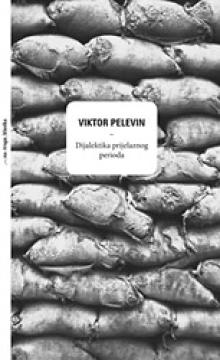
Dijalektika prijelaznog perioda

Viktor Pelevin

The book represents the author's anthology - the largest part is the novel Čisla (Čisla), followed by the short story Macedonian Criticism of French Thought and several short stories (Odin vog, Akiko, Fokus-grupa, Gost na prazniku bon).

At the heart of Chisla's novel is Stepa (Stepan), an oligarch of the new Russian capitalism of the 90s/2000s. He is obsessed with numbers: his "solar" number 34 (symbol of power, success) clashes with "lunar" 43 (symbol of ruin, Chubais and liberals). Stepa builds his life around the numerological cabal - he chooses numbers for phones, rooms, cars, lovers, jobs - believing that in this way he will control destiny. But the crisis of 1998 and the political turmoil shatter the illusion: the numbers turn against him, leading to paranoia, hallucinations and existential decline.

Pelevin mocks post-Soviet Russia: oligarchs, mafia, politics, Buddhism, New Age, capitalism and spirituality as commodities. Dialectic is a parody of Marxism – the transition from nowhere (Soviet nothingness) to nowhere (the new Russian chaos), where nothing changes, only repeats itself in new forms.

The stories are short, absurd, Buddhist-satirical: about virtual sex, Japanese culture, focus groups and "bon" (Buddhist holiday of the dead). The entire book is a cynical, witty critique of the transition – from communism to capitalism, from the material to the virtual, from nothingness to nothingness – with Pelevin's signature blend of philosophy, pop culture and dark humor.

Original title
Диалектика Переходного Периода из Ниоткуда в Никуда
Translation
Irena Lukšić
Illustrations
Stanko Abadžić
Dimensions
20 x 12.5 cm
Pages
316
Publisher
Disput, Zagreb, 2006.
 
Latin alphabet. Paperback.
Language: Croatian.

One copy is available

Condition:Used, excellent condition
 

Are you interested in another book? You can search the offer using our search engine or browse books by category.

You may also be interested in these titles

Doba života, doba smrti / Slavoluk pobjede / Ljubi bližnjega svoga

Doba života, doba smrti / Slavoluk pobjede / Ljubi bližnjega svoga

Erich Maria Remarque

Selected works of Remarque in three volumes.

SKD Prosvjeta, 1963.
Croatian. Latin alphabet. Hardcover.
The book consists of 3 volumes
9.56
Proces

Proces

Franz Kafka

Kafka wrote The Process between 1914 and 1915, published posthumously in 1925. The novel is unfinished but with an added final chapter by Max Brod. Edition with a foreword by B. Živojinović and an afterword by Walter Killi.

BIGZ, 1990.
Serbian. Latin alphabet. Paperback.
4.26
Eva Luna

Eva Luna

Isabel Allende

Eva Luna is a novel about a poor storyteller who weaves lives with words, written by Isabel Allende, the founder of Latin American magical realism. Published after the success of The House of the Spirits, this whirlwind of adventure combines love, revolut

Znanje, 1990.
Croatian. Latin alphabet. Hardcover with dust jacket.
8.36
Zagrepčanka

Zagrepčanka

Branislav Glumac

Branislav Glumac published a novel without periods or commas in 1974, as the relentless stream of thought of a young rebel. Published in socialist Yugoslavia, the work caused a scandal with its openness and became a classic about generational rebellion.

IROS, 1986.
Croatian. Latin alphabet. Hardcover.
8.22 - 8.24
Neprijatelji / ljubavna priča

Neprijatelji / ljubavna priča

Isaac Bashevis Singer

Enemies: A Love Story, perhaps Singer's best-known novel, takes place in New York in the 1950s.

Svjetlost, 1986.
Croatian. Latin alphabet. Hardcover with dust jacket.
5.984.49
Crna kutija

Crna kutija

Amos Oz

The Black Box is a kaleidoscope of married life and love relationships. It is a novel that implicitly speaks about all of us.

Hena Com, 2001.
Croatian. Latin alphabet. Hardcover.
10.98