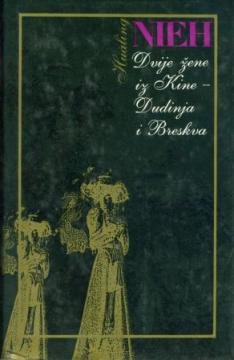
Dvije žene iz Kine: Dudinja i Breskva

Dvije žene iz Kine: Dudinja i Breskva

Hualing Nieh

The novel follows the fate of a young Chinese woman, Dudinja, who flees war and revolution in China in the 1940s and 1950s. The novel, banned in China for its political and sexual themes, explores trauma and schizophrenia through the story of Dudinja deve

The story unfolds in four parts, combining the diary entries of Dudinja and the letters of Peach to an American immigration officer.

During World War II, the adolescent Dudinja flees the Japanese invasion, caught on a boat on the Yangtze River. Later, in Beijing, she faces the communist revolution, and after fleeing to Taiwan, she hides with her husband, accused of embezzlement, in an attic, where their daughter develops a fantasy world. In the final part, Dudinja arrives in the United States, persecuted by the immigration service. There, Peach appears, her rebellious, sexually liberated persona, who rejects her Chinese roots and ridicules Dudinja.

The novel combines historical allegory, political satire, and a feminist perspective, exploring cultural dislocation and psychological fragmentation. Nieh depicts the struggle between traditional values and modernization with humor and irony, making the work significant in the context of Chinese and immigrant literature.

Original title
Two Women of China
Translation
Mate Maras
Editor
Mirjana Buljan
Dimensions
21 x 14 cm
Pages
258
Publisher
Globus, Zagreb, 1985.
 
Latin alphabet. Hardcover with dust jacket.
Language: Croatian.

Two copies are available

Copy number 1

Condition:Used, excellent condition

Copy number 2

Condition:Used, excellent condition
 

Are you interested in another book? You can search the offer using our search engine or browse books by category.

You may also be interested in these titles

Stotina godina (antikronika)

Stotina godina (antikronika)

Dario Harjaček

The novel One Hundred Years by Dario Harjaček provides a panoramic view of Trešnjevka and its inhabitants through a century of changes, ideologies, and human destinies – a mosaic of Zagreb in which life, art, and history intertwine.

Oceanmore, 2025.
Croatian. Latin alphabet. Paperback.
13.42
Proces

Proces

Franz Kafka

Kafka wrote The Process between 1914 and 1915, published posthumously in 1925. The novel is unfinished but with an added final chapter by Max Brod. Edition with a foreword by B. Živojinović and an afterword by Walter Killi.

BIGZ, 1990.
Serbian. Latin alphabet. Paperback.
4.26
Kreutzerova sonata, Hadži-Murat

Kreutzerova sonata, Hadži-Murat

Lav Nikolajevič Tolstoj

Kreutzer's sonata belongs to those works of Tolstoy that the writer adapted in many ways to his view on moral issues, on marital morality above all.

Civitas, 2004.
Croatian. Latin alphabet. Paperback.
4.98
Zvezde su tamne

Zvezde su tamne

Peter Cheyney

"The stars are dark" is a spy thriller by the British writer Peter Cheyney, known for fast, tense stories and hard-boiled characters.

Svjetlost, 1965.
Serbian. Latin alphabet. Paperback.
2.96 - 3.26
I ne reče ni reči

I ne reče ni reči

Heinrich Böll

In Boll's novels, one of the central themes is the attempt to preserve basic moral values ​​in a time of terror, as well as in a period of material prosperity and corruption.

Svjetlost, 1965.
Serbian. Latin alphabet. Paperback.
3.22 - 3.98
Dok ležah na samrti

Dok ležah na samrti

William Faulkner

Faulkner's 1930 novel, a classic example of modernist literature. It is often compared to Joyce's "Ulysses" for its innovative structure, but is more accessible due to its focus on family.

Rad, 1985.
Croatian. Latin alphabet. Paperback.
3.26