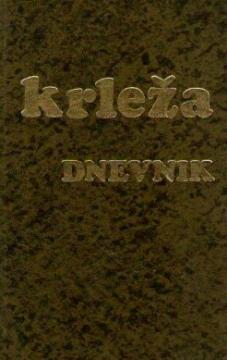
Dnevnik 3: Dnevnik 1933 - 42

Dnevnik 3: Dnevnik 1933 - 42

Miroslav Krleža
Editor
Enes Čengić, Anđelko Malinar
Dimensions
20 x 13 cm
Pages
488
Publisher
NIŠRO Oslobođenje, Sarajevo, 1981.
 
Latin alphabet. Hardcover.
Language: Croatian.

No copies available

The last copy was sold recently.


Are you interested in another book? You can search the offer using our search engine or browse books by category.

You may also be interested in these titles

Izabrane pjesme

Izabrane pjesme

Miroslav Krleža
Matica hrvatska, 1963.
Croatian. Latin alphabet. Hardcover with dust jacket.
9.99
Povratak Filipa Latinovicza

Povratak Filipa Latinovicza

Miroslav Krleža

The Return of Filip Latinovicz is one of Miroslav Krleža's most famous novels. This novel is significant in our literature because it is considered the first fully modern Croatian novel.

Večernji list, 2004.
Croatian. Latin alphabet. Hardcover with dust jacket.
5.52 - 5.56
Hrvatski bog Mars

Hrvatski bog Mars

Miroslav Krleža
Rad, 1965.
Serbian. Latin alphabet. Paperback.
1.99
Pjesnik govori: filozofsko-estetske kozerije

Pjesnik govori: filozofsko-estetske kozerije

Drago Ćepulić

"The Poet Speaks: Philosophical-Aesthetic Riddles" by Dragutin (Drago) Ćepulić is a collection of short, thoughtful essays in which the author reflects on literature, art, philosophy, and human creativity in a witty, insightful, and unobtrusive manner.

Minerva nakladna knjižara, 1943.
Croatian. Latin alphabet. Paperback.
6.24
Moj Argentinski Tango - ispovest Mornara Pešića

Moj Argentinski Tango - ispovest Mornara Pešića

Predrag Aleksijević

The book is an authentic, poignant, and humorous confession of the Belgrade sailor and bohemian Milorad Mornar Pešić (1934–2018), which Predrag Aleksijević wrote down and shaped into a confessional novel.

NIRO Exportpress, 1984.
Serbian. Latin alphabet. Paperback with dust jacket.
5.26
Jugoslavenstvo danas

Jugoslavenstvo danas

Predrag Matvejević

Yugoslavism Today (1982) examines the concept of Yugoslavism in the context of the political, cultural, and social conditions of the SFR Yugoslavia, in the period after Tito's death. The work explores the historical roots of the Yugoslav idea and the chal

Globus, 1982.
Croatian. Latin alphabet. Hardcover with dust jacket.
8.56