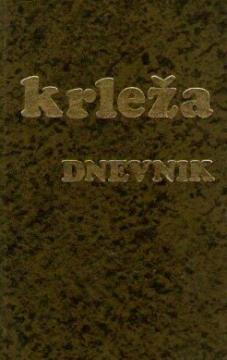
Dnevnik 4: Dnevnik 1943

Dnevnik 4: Dnevnik 1943

Miroslav Krleža
Editor
Enes Čengić, Anđelko Malinar
Dimensions
20 x 13 cm
Pages
365
Publisher
NIŠRO Oslobođenje, Sarajevo, 1981.
 
Latin alphabet. Hardcover.
Language: Croatian.

No copies available

The last copy was sold recently.


Are you interested in another book? You can search the offer using our search engine or browse books by category.

You may also be interested in these titles

Izabrane pjesme

Izabrane pjesme

Miroslav Krleža
Matica hrvatska, 1963.
Croatian. Latin alphabet. Hardcover with dust jacket.
9.99
Povratak Filipa Latinovicza

Povratak Filipa Latinovicza

Miroslav Krleža

The Return of Filip Latinovicz is one of Miroslav Krleža's most famous novels. This novel is significant in our literature because it is considered the first fully modern Croatian novel.
Večernji list, 2004.
Croatian. Latin alphabet. Hardcover with dust jacket.
5.523.86 - 5.56
Hrvatski bog Mars

Hrvatski bog Mars

Miroslav Krleža

The Croatian god Mars brings seven anti-war novels in which Krleža portrays war as a cruel, senseless machinery that destroys the "little man", exposing the hypocrisy of militarism and myths about heroism.

Rad, 1965.
Serbian. Latin alphabet. Paperback.
1.99
Humoristička proza

Humoristička proza

Branislav Nušić

Humorous prose brings together Nušić's autobiographical, essay-serial and narrative texts, in which humor and satire expose school, society, government and human weaknesses.

SKD Prosvjeta, 1951.
Serbian. Cyrillic alphabet. Hardcover.
7.64
Kad čujem Daruvar

Kad čujem Daruvar

Stanko Andrić, Josip Vujčić, Želimir Periš, Monika Herceg, Selvedin Avdić, Mladen Blažević, Marko...

The collection "When I Hear Daruvar", edited by Kruno Lokotar, brings together 28 stories, essays and travelogues by renowned authors on the topic of Daruvar - a unique literary portrait of the city.

Jesenski i Turk, 2021.
Croatian. Latin alphabet. Hardcover.
13.42
Znamenovanje ruske revolucije

Znamenovanje ruske revolucije

Lav N. Tolstoj

Tolstoy interprets the 1905 revolution as a moral upheaval: violence does not bring justice, but a new yoke. He sees lasting liberation in personal conscience, non-violence and Christian love, not in the state and coercion.

St. Kugli, 1907.
Croatian. Latin alphabet. Hardcover.
17.24