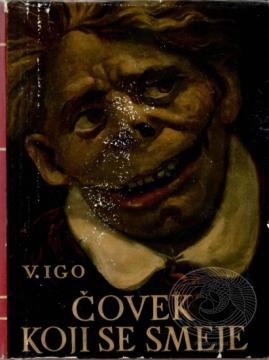
Čovek koji se smeje

Čovek koji se smeje

Victor Hugo
Original title
L'homme qui rit
Translation
Dragoslav Smiljanić
Graphics design
Aleksandar Hecl, Petar Dabović
Dimensions
19.5 x 15 cm
Pages
600
Publisher
Rad, Beograd, 1954.
 
Latin alphabet. Hardcover with dust jacket.
Language: Serbian.

No copies available

The last copy was sold recently.
 

Are you interested in another book? You can search the offer using our search engine or browse books by category.

You may also be interested in these titles

Cosette, Gavroche

Cosette, Gavroche

Victor Hugo
Mladost, 1971.
Croatian. Latin alphabet. Hardcover.
6.224.65 - 6.64
Zvonar bogorodičine crkve

Zvonar bogorodičine crkve

Victor Hugo

The Bell Tower (1831) is not just a story of love and tragedy – it is a vivid picture of Paris on the threshold of the Renaissance, where the Gothic Notre-Dame Cathedral becomes almost the main character, a living being of stone that breathes history, suf

Svjetlost, 1973.
Serbian. Latin alphabet. Hardcover.
The book consists of two volumes
7.38
Bogorodičina crkva u Parizu

Bogorodičina crkva u Parizu

Victor Hugo

At the center of Hugo's monumental work and one of the most significant novels of French literature, there are three exceptional characters caught in a web of passion and revenge.

Svjetlost, 1982.
Croatian. Latin alphabet. Hardcover.
4.82
Usta puna zemlje

Usta puna zemlje

Branimir Šćepanović

The novel "Usta puna zemlje" (1970), the masterpiece of the Serbian writer Branimir Šćepanović, is a psychologically in-depth explorer of the limits of the human soul, solitude and existential freedom, reminiscent of Kafka and Camus.

BIGZ, 1987.
Serbian. Latin alphabet. Paperback.
3.98
Deobe 1-3

Deobe 1-3

Dobrica Ćosić

This work, awarded the NIN Prize for that year, is considered one of the most significant in Serbian literature after World War II.

Prosveta, 1961.
Serbian. Cyrillic alphabet. Hardcover with dust jacket.
The book consists of 3 volumes
11.42
Deobe

Deobe

Dobrica Ćosić

Deobe is a novel about the tragic division of Serbs into Chetniks and Partisans during World War II. Winner of the NIN Award, it is part of a wider epic trilogy, inspired by Ćosić's experiences and historical documents.

Prosveta, 1963.
Croatian. Latin alphabet. Hardcover with dust jacket.
13.74