Victor Hugo
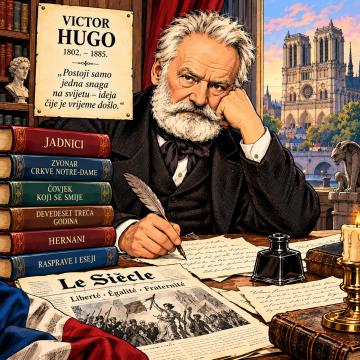
Victor Hugo (1802–1885), a French writer, poet, playwright, and political thinker, was born on February 26, 1802, in Besançon and died on May 22, 1885, in Paris. He is considered one of the greatest figures of French Romanticism and one of the most influential European writers of the 19th century. His body of work encompasses novels, poetry, plays, and essays, and is characterized by humanism, social criticism, and the struggle for justice and freedom.
He grew up in the family of a Napoleonic officer and began his literary career at a very young age. He published his first poetry collection, Odes et poésies diverses (1822), at the age of twenty. He soon became a leading figure of French Romanticism, particularly with the play Hernani (1830), the premiere of which marked a major turning point in the history of French theater.
He achieved worldwide fame with the novel The Hunchback of Notre-Dame (Notre-Dame de Paris, 1831)—a historical tale about Quasimodo and Esmeralda—in which he explores themes of love, prejudice, social injustice, and human cruelty.
His most famous work, Les Misérables (1862), is a monumental novel about Jean Valjean, an ex-convict attempting to build a new life. Through the fates of numerous characters, Hugo portrays poverty, inequality, redemption, and the conflict between the law and moral conscience.
Other notable novels include Toilers of the Sea (1866), The Man Who Laughs (1869), and Ninety-Three (1874). His poetry reached its peak with the collections Contemplations (1856) and The Legend of the Centuries (1859–1883).
Hugo was also politically active. Due to his opposition to Napoleon III, he spent nearly twenty years in exile, primarily in the Channel Islands. He advocated for freedom of speech, the abolition of the death penalty, and the protection of the disenfranchised.
His works are characterized by powerful emotions, rich symbolism, epic storytelling, and moral engagement. Victor Hugo left an indelible mark on world literature, and his novels continue to inspire readers as well as creators in theater and film.
Titles in our offer
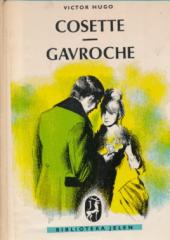
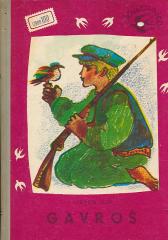
Gavroš
A touching story drawn from the novel *Les Misérables* follows the brave and fearless Parisian boy Gavroche, who, through his cheerfulness, defiance, and selfless sacrifice, becomes a symbol of the fight for freedom and justice.

Jadnici
An epic tale of redemption, sacrifice and hope, with an emphasis on the moral struggle of the individual in a ruthless society. Hugo's ability to combine philosophical depth with suspenseful action makes the work timeless, and its message of justice and h
Jadnici - 1. dio
Roman prati živote i odnose nekoliko francuskih likova tokom dvadesetogodišnjeg perioda u ranom 19. veku koji uključuje Napoleonovo doba i decenije nakon njega.
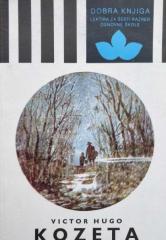
Kozeta
Kozeta je izmišljeni lik u romanu „Jadnici“ Viktora Igoa iz 1862. godine i u mnogim adaptacijama priče za pozorište, film i televiziju. Njeno ime po rođenju, Eufrazije, pominje se samo ukratko.

Kozeta
*Kozeta* prati nesrećno detinjstvo devojčice Kozete, koju porodica Tenardije zlostavlja, kao i njeno spasavanje nakon susreta sa Žan Valžanom. Priča govori o patnji, dobroti, ljubavi i nadi u bolji život.
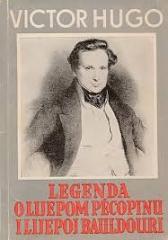
Legenda o lijepom Pécopinu i lijepoj Bauldouri
Romantična priča Viktora Igoa, 21. pismo iz njegovog putopisa „Le Rhin“ („Rajna“, 1842). Romantični klasik, sličan bajkama braće Grim ili Andersena, ali sa Igoovom dubokom emotivnošću i filozofijom večne ljubavi.

Zvonar bogorodičine crkve
Zvonik (1831) nije samo priča o ljubavi i tragediji – to je živopisna slika Pariza na pragu renesanse, gde gotska katedrala Notr Dam postaje gotovo glavni lik, živo biće od kamena koje diše istorijom, patnjom i lepotom.
Zvonar crkve Notre-Dame
Igoov roman o srednjovekovnom Parizu krajem 15. veka, napisan u duhu romantizma. To je roman ljudskih strasti, roman o tri nesrećne ljubavi, ali pre svega je ep o Katedrali kao „glavnom liku“ i predstavniku cele jedne epohe na zalasku.