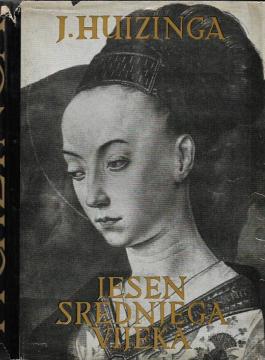
Jesen srednjega vijeka
Rare book

Jesen srednjega vijeka

Johan Huizinga

The classic book by the prominent Dutch historian Johan Huizinga (1872-1945) “The Autumn of the Middle Ages” was published a hundred years ago, in 1919, and remains one of the most famous works on the Middle Ages to this day.

The Autumn of the Middle Ages is a classic historiographical work by the Dutch historian Johan Huizinga, which depicts cultural and social life in France and the Netherlands during the 14th and 15th centuries. Rather than focusing on political events, Huizinga analyzes the mentality, symbolism, and everyday life of people towards the end of the Middle Ages.

Huizinga portrays the period as a time of decadence and emotional over-emphasis, dominated by pessimism, mysticism, and intense religiosity. The art and literature of the period are permeated with images of death, moral sermons, and rituals that reflect a deep insecurity and a sense of the end of the world.

The author argues that the end of the Middle Ages was not an abrupt break, but a slow “withering away” of old values, as seen through the culture of courtly customs, chivalric ideals, and ceremonialism. Although often perceived as a dark age, Huizinga shows that it was also a period of great sensitivity, imagination, and spiritual intensity.

The work is pioneering in cultural history and, although controversial, remains essential reading for understanding the transition from the Middle Ages to the Renaissance.

Original title
Herfsttij der Middeleeuwen
Translation
Drago Perković
Editor
Grgo Gamulin
Graphics design
Valerija Pavić
Dimensions
22 x 16 cm
Pages
405
Publisher
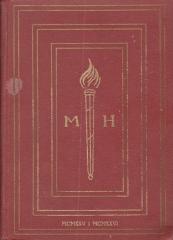
Matica hrvatska, Zagreb, 1964.
 
Latin alphabet. Hardcover with dust jacket.
Language: Croatian.

No copies available

The last copy was sold recently.
 

Are you interested in another book? You can search the offer using our search engine or browse books by category.

You may also be interested in these titles

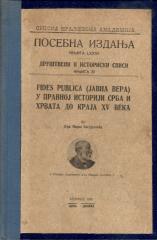
Fides publica (Javna vera) u pravnoj istoriji Srba i Hrvata do kraja XV veka

Fides publica (Javna vera) u pravnoj istoriji Srba i Hrvata do kraja XV veka

Marko Kostrenčić

"Fides publica (Public Faith)" (1930) is a notable legal-historical study by Marko Kostrenčić on the development of public credibility of documents, notarial institutions, and legal certainty in medieval Croatian and Serbian lands.

24 sata, 1930.
Serbian. Cyrillic alphabet. Hardcover.
14.62
Povijest Bosne u doba osmanlijske vlade I-II

Povijest Bosne u doba osmanlijske vlade I-II

Milan Prelog

An overview of Ottoman rule in Bosnia through political, social and economic changes and the creation of a new order. Reprint from 1913.

Fortuna d.o.o., 2023.
Croatian. Latin alphabet. Hardcover.
20.00
Srednjevekovna srpska država: izabrani izvori

Srednjevekovna srpska država: izabrani izvori

Sima Ćirković

"The Medieval Serbian State - Selected Sources" is a school collection of primary historical sources for teaching medieval Serbian history in secondary schools in Yugoslavia.

Školska knjiga, 1959.
Croatian. Latin alphabet. Paperback.
6.745.06
Hram i loža

Hram i loža

Michael Baigent, Richard Leigh

Although considered controversial by historians and often criticized as speculative and lacking solid evidence, the book is indispensable and extremely influential – it directly inspired Dan Brown's "The Da Vinci Code" and the entire genre of esoteric lit

Stari grad, 2005.
Croatian. Latin alphabet. Hardcover.
17.2212.92 - 17.2812.96
Izgon Mongola iz Hrvatske

Izgon Mongola iz Hrvatske

Ante Tresić-Pavičić

The book The Expulsion of the Mongols from Croatia, published in 1942 on the occasion of the seven hundredth anniversary of the Mongol invasion and the events of 1242, is one of the most famous historical works by Ante Tresić-Pavičić.

Matica hrvatska, 1942.
Croatian. Latin alphabet. Hardcover.
7.265.08
Hrvatski narodni vladari od god. 620.–1102.

Hrvatski narodni vladari od god. 620.–1102.

Mate Sagher

A pioneering attempt at a systematic presentation of Croatian political history from the settlement of Croats to the conclusion of a personal union with Hungary. Segher chronologically traces the development of Croatian statehood, relying on the sources a

Dionička tiskara, 1903.
Croatian. Latin alphabet. Paperback.
14.76