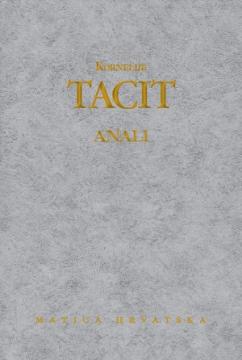
Anali

Anali

Kornelije Tacit

Sine ira et studio is Tacitus' motto that he had in mind when writing his works, the best historical and biographical texts of Roman literature. But is it possible to write about emperors, tyrants and their sycophants without anger and bias if you are a born anti-monarchist, if you tend to understand history skeptically, tragically, and even fatalistically, if you are not interested in external causes and events, but in their protagonists whose fate and action more determines their bad character?

Maybe it is possible, but only if, like Tacitus, you can be poetic and pathetic, while using a lot of ironic and sarcastic remarks; or, if you convince the reader that as an observer and chronicler you are completely objective, even though you are subjective, because you wouldn't want to be different when you are primarily interested in the drama of characters, events and details, the characterization and psychology of the protagonist, and in fact you are writing about human passions, because you deeply believe how in all things the capriciousness of human destiny shows itself more and more! And this is precisely where the literary genius of the historian Tacitus is hidden: there is no good literature without good protagonists and even better antagonists. That is why in Tacitus we find psychological nuances and dramatization of personal and collective failures. That's why Tacitus' historical works are not only history, or more precisely the historical interpretation of a period, but also literary portraits of emperors and politicians, fascinatingly evil characters, strong, wickedly strong villains.

Original title
Annales
Translation
Josip Miklić
Editor
Josip Miklić
Dimensions
21 x 14 cm
Pages
757
Publisher
Matica hrvatska, Zagreb, 2006.
 
Latin alphabet. Hardcover.
Language: Croatian.

No copies available

The last copy was sold recently.


Are you interested in another book? You can search the offer using our search engine or browse books by category.

You may also be interested in these titles

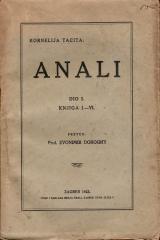
Anali: Dio I. (knjiga I.–VI.)

Anali: Dio I. (knjiga I.–VI.)

Kornelije Tacit

The first part of Tacitus' famous work on the early Roman Empire, covering the period from the death of Augustus to the end of the reign of Tiberius. The second part was not published in this edition. The first translation of the Annals into Croatian.

Naklada Braća Kralj, 1923.
Croatian. Latin alphabet. Paperback.
15.32
Užasi povijesti: Strašni Egipćani

Užasi povijesti: Strašni Egipćani

Terry Deary, Peter Hepplewhite

The book depicts life in ancient Egypt in a humorous and entertaining way. Readers learn about the pharaohs, mummies, pyramids, gods, and the everyday life of Egyptians through interesting facts.

Egmont, 2002.
Croatian. Latin alphabet. Paperback.
8.32
Arktička pradomovina Veda

Arktička pradomovina Veda

Bal Gandahar Tilak

The book The Arctic Homeland of the Vedas (1903) by the Indian scholar Tilak proposed the hypothesis that the ancient Aryans, the authors of the Rigveda, originated in the Arctic region. Although controversial, the book remains important in the study of V

NIRO Književne novine, 1987.
Serbian. Latin alphabet. Paperback.
17.56
Ciklus svemirskih katastrofa: Potopi, požari i skapavanja u povijesti civilizacije

Ciklus svemirskih katastrofa: Potopi, požari i skapavanja u povijesti civilizacije

Richard Firestone, Allen West, Simon Warwick-Smith

The book is the most readable and complete overview of the evidence that human civilization has already been nearly wiped out of the universe once – and that such cycles may repeat themselves every few tens of thousands of years.

Stari grad, 2007.
Croatian. Latin alphabet. Hardcover.
21.2214.94 - 21.3421.28
Kraj vremena: Revizija proročanstva Maya

Kraj vremena: Revizija proročanstva Maya

Adrian Gilbert

British author Adrian Gilbert (co-author of The Mayan Prophecies from 1995) in The End of Time offers the most thorough and sober modern interpretation of the Mayan calendar and the so-called "2012 prophecy", completely rejecting New Age hysteria.

Stari grad, 2009.
Croatian. Latin alphabet. Hardcover.
18.2214.58 - 18.2414.59
Kultura neandertalaca: Čuvari drevne mudrosti

Kultura neandertalaca: Čuvari drevne mudrosti

In this strongly documented book, the British psychologist and researcher claims that Neanderthals were the bearers of an older, more powerful, and spiritually richer culture than Cro-Magnon ("modern" man), and that it was their tradition that formed the

Stari grad, 2006.
Croatian. Latin alphabet. Hardcover.
14.2410.68 - 14.28