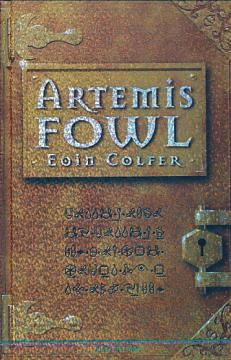
Artemis Fowl

Artemis Fowl

Eoin Colfer

Irish children's writer Eoin Colfer came up with the character of a boy anti-hero in a fantastic setting of a fairy world which, unlike ancient fairy tales, has been modernized with the technology of the future.

All the worries of the world seemed to fall on the fragile shoulders of twelve-year-old Artemis Fowl. His father, otherwise the head of an Irish criminal organization, died after a dubious deal with the Russian mafia. His mother's mind simply went blank with grief. With the help of two loyal servants, Butler and Juliette, Artemis will have to miss the new school year and take control of the family estate and affairs.

But Artemis Fowl is not an ordinary twelve-year-old, he is still his father's son, highly educated, supernaturally cunning and brought up not to choose any means on the way to the goal, neither laws, nor moral considerations, nor terrifying opponents will prevent him from getting his hands on a ton of gold.

Following a series of almost invisible clues, Artemis Fowl discovered that the fairy world really exists, got hold of the fairy book of spells and rules, and planned to kidnap the real fairy, if he could ask for a rich ransom for her according to the complex rules of fairy society. When he actually succeeds, he will find that he actually kidnapped Holly Short, a member of the special elven police force. It looks like Artemis Fowl will finally meet a worthy, if rather charming, opponent.

Translation
Dubravka Petrović
Editor
Neven Antičević
Illustrations
Tony Fleetwood
Dimensions
24 x 16 cm
Pages
2005
Publisher
Algoritam, Zagreb, 2001.
 
Distribution: 3,000 copies
 
Latin alphabet. Hardcover.
Language: Croatian.
ISBN
9-53-220017-7

No copies available

The last copy was sold recently.
 

Are you interested in another book? You can search the offer using our search engine or browse books by category.

You may also be interested in these titles

Obračun s dr. Dongom

Obračun s dr. Dongom

Josef Nesvadba

The motif that Nesvadba has already used in a science fiction context, the FALSIFICATION OF AN ARCHAEOLOGICAL FIND, in "The Showdown with Doctor Dong" serves as a starting point for questioning the RELATIONSHIP BETWEEN REVOLUTION AND SCIENTIFIC TRUTH.

Epoha, 1965.
Croatian. Latin alphabet. Hardcover with dust jacket.
4.25
Kanjoni noći

Kanjoni noći

Jayne Castle

Canyons of Night (2011) by Jayne Castle (pseudonym Jayne Ann Krentz) is the third and final novel in the "Mirror" trilogy. Typical of Castle/Krentz: a strong heroine, a protective hero, psi-energy, mystery, and light eroticism.

Leo Commerce, 2014.
Croatian. Latin alphabet. Hardcover.
9.74
Radium: roman jednog elementa

Radium: roman jednog elementa

Rudolf Brunngraber

A scientific documentary novel about the discovery of radium, which tells the story of Marie and Pierre Curie, the medical revolution, but also the dark side – speculation, the fight for monopoly and the tragic consequences of radioactivity on people.

Nakladni zavod Ante Velzek, 1940.
Croatian. Latin alphabet. Hardcover with dust jacket.
9.24
Digitalni ugljik

Digitalni ugljik

Richard Morgan

The first part of a trilogy about Takeshi Kovacs – a dark, violent, but intellectually provocative SF noir. The world of the future in Morgan's Digital Carbon is a cruel extrapolation of globalization, but at its core it is a classic noir crime novel.

Algoritam, 2006.
Croatian. Latin alphabet. Hardcover.
19.52
Obmanuti ljubavnici

Obmanuti ljubavnici

Ben Barzam

In the novel "Deceptive Lovers", the author develops the motif of PARALLEL WORLDS, keeping in mind, first of all, the ANTI-WAR message, but unfortunately not the logical coherence of the work.

Epoha, 1965.
Croatian. Latin alphabet. Hardcover with dust jacket.
4.82
Četrdeset tisuća milja ispod mora

Četrdeset tisuća milja ispod mora

Jules Verne

The novel Forty Thousand Leagues Under the Sea (also known as Twenty Thousand Leagues Under the Sea, depending on the translation), published in 1870, is one of Jules Verne's most famous works and a classic of science fiction.

Novo pokoljenje, 1951.
Croatian. Latin alphabet. Hardcover with dust jacket.
8.56