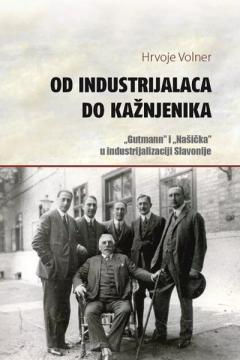
Od industrijalaca do kažnjenika: “Gutmann” i “Našička” u industrijalizaciji Slavonije

Od industrijalaca do kažnjenika: “Gutmann” i “Našička” u industrijalizaciji Slavonije

Hrvoje Volner

The book follows the rise and fall of Croatian industrialists who, after political and economic changes, ended up under investigation, indictments, or convictions, analyzing the relationship between business, politics, and the judiciary.

From Industrialists to Convicts by Hrvoje Volner explores the complex relationship between the economy, politics, and the judiciary through stories about Croatian entrepreneurs who marked the period of transition. The book analyzes how individual industrialists went from being symbols of economic success to becoming the subject of criminal investigations, court trials, or final judgments, raising questions of responsibility, privatization, corporate governance, and the functioning of institutions.

The author provides an overview of key cases, placing them in a broader social and historical context, and seeks to explain the circumstances that led to the rise and fall of former business leaders. Instead of simple conclusions, the book encourages the reader to reflect on the boundaries between entrepreneurial risk, political influence, and criminal responsibility.

It is intended for anyone interested in Croatian economic history, transition processes, business ethics, and the functioning of the judicial system. Through a documented account of events and actors, the book provides insight into one of the most dynamic and controversial periods of the contemporary Croatian economy.

Editor
Krešimir Maligec
Dimensions
24 x 15 cm
Pages
234
Publisher
Srednja Europa, Zagreb, 2019.
 
Latin alphabet. Paperback.
Language: Croatian.
ISBN
978-9-53828-106-8

One copy is available

Condition:Unused
 

Are you interested in another book? You can search the offer using our search engine or browse books by category.

You may also be interested in these titles

Dubrovačke slike i prilike (1800-1880.)

Dubrovačke slike i prilike (1800-1880.)

Josip Bersa

Josip Bersa's book vividly depicts the social, political, and cultural life of Dubrovnik in the 19th century, combining historical facts and personal memories into a picturesque portrait of the city in a period of change.

Matica hrvatska, 1941.
Croatian. Latin alphabet. Hardcover.
19.54
Putovanje po Bosni

Putovanje po Bosni

Ivan Kukuljević Sakcinski

Ivan Kukuljević Sakcinski's travelogue provides a vivid account of Bosnia in the mid-19th century, recording the landscape, customs, political circumstances, and everyday life under Ottoman rule.

Fortuna d.o.o., 2007.
Croatian. Latin alphabet. Hardcover.
14.60
Povijest i kultura Hrvata kroz 1000 godina: Od velikih seoba do XVIII. stoljeća

Povijest i kultura Hrvata kroz 1000 godina: Od velikih seoba do XVIII. stoljeća

Horvat
Josip Horvat

One of the most prominent Croatian cultural historians, Josip Horvat, in one of his best texts, not only describes the cultural achievements of Croats, but also analyzes them on the basis of political, social and other events that Croatian history is full

Knjigotisak d. o. o., 2009.
Croatian. Latin alphabet. Hardcover.
12.20
Dan kada je nastala država Hrvatska 1991.

Dan kada je nastala država Hrvatska 1991.

Davorin Rudolf, Vladimir Šeks, Jasna Omejec

The collection brings together scholarly works on key political, legal, and diplomatic processes that led to the creation of the Croatian state in 1991, analyzing the decisions, actors, and international circumstances crucial to independence.

Hrvatska akademija znanosti i umjetnosti (HAZU), 2015.
Croatian. Latin alphabet. Paperback.
17.26
Komunizam i čovjek: Odnos vlasti i pojedinca u Hrvatskoj (1958.–1972.)

Komunizam i čovjek: Odnos vlasti i pojedinca u Hrvatskoj (1958.–1972.)

Josip Mihaljević

Josip Mihaljević's book analyzes the relationship between the government and the individual in communist Croatia (1958–1972), through repressive mechanisms, ideological pressures, and restrictions on personal freedom in the socialist system.

Hrvatski institut za povijest, 2016.
Croatian. Latin alphabet. Hardcover.
17.26
Starohrvatska seoska zajednica

Starohrvatska seoska zajednica

Miho Barada

In his work Starohrvatska seoska zajednica (The Old Croatian Village Community) (1957), Miho Barada analyzes the social and agrarian organization of early medieval Croatian villages, their institutions, ownership relations, and common land based on origin

Jugoslavenska akademija znanosti i umjetnosti (JAZU), 1957.
Croatian. Latin alphabet. Paperback.
10.00