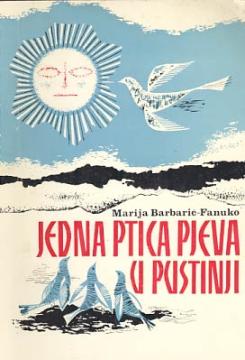
Jedna ptica pjeva u pustnji

Jedna ptica pjeva u pustnji

Marija Barbarić-Fanuko

One bird sings in the desert, a collection of stories by the Croatian writer Marija Barbarić-Fanuko (published in 1968), was reprinted more than half a century after the first edition.

From the desert of oblivion and carelessness for a collection of stories that is special in many respects, not only the song and melody of the story but also the bird, its image and its habitat have returned to us.

Marija Barbarić-Fanuko is first and foremost a poet, and only then a storyteller. Therefore, at the beginning of the collection, before all eighteen of her stories, there is a poem as a kind of prolegomena. It informs us that it is about stories about a Flower and a Star, about their longing to meet, about their nearness and distance, about day and night, about a spark and a Bird in flight... The capital letters of the common nouns flower, star and bird indicate that it is not about characters but about concepts, metaphors and symbols. (...)

Marija Barbarić-Fanuko's stories resemble cut precious stones, with recognizable colors and cut shapes, a constant shine that will reflect in the spirit of every reader: either the one who dreams and imagines while reading, or the one who draws conclusions and realizes while reading. All readers will come to the right measure - to the measure of their age, their experience and their openness. It is about deeply human, archetypal stories and symbols, desires and needs; above all, ways to recognize and recognize it. The world in these eighteen stories is simple, clean and transparent. In short: clear, but not ideal. Fairytale, but not in the usual way. Stories are like wells on a long journey. Some stories are therefore a compass, some are binoculars, and some are signposts on a map.

Illustrations
Ivo Fanuko
Graphics design
Ivo Fanuko
Dimensions
20.5 x 14.5 cm
Pages
82
Publisher
Vlastita naklada, Zagreb, 1968.
 
Latin alphabet. Paperback.
Language: Croatian.

No copies available

The last copy was sold recently.
 

Are you interested in another book? You can search the offer using our search engine or browse books by category.

You may also be interested in these titles

Iz jednog džepa

Iz jednog džepa

Dragan Lukić

The classic of our children's literature collected stories and poems - short and various, in this book, as if in one pocket where only selected things can remain.

Svjetlost, 1989.
Croatian. Latin alphabet. Hardcover.
3.98
Udžbenik priča za završne razrede odrastanja

Udžbenik priča za završne razrede odrastanja

Josip Cvenić

Fairy tales are not rivers of the abyss, so at some time and in some country they don't exist, and then they appear again. No, they are everywhere and always present rivers of stories.

Slon, 1995.
Croatian. Latin alphabet. Paperback.
3.32
Tajni dnevnik Adriana Molea (13 3/4 god.)

Tajni dnevnik Adriana Molea (13 3/4 god.)

Sue Townsend

"Adrian is a fictional character who evokes a rare affection and warmth in the reader. Through Adrian's eyes, we see what he sees and more, and what springs between the lines is both sad and poignant and hilariously funny. A delight for all generations."

Znanje, 1986.
Croatian. Latin alphabet. Paperback.
4.56
Prva ljubav

Prva ljubav

Miroslav Antić

The book First Love by Miroslav Mika Antić is a collection of poetry that explores the experience of first love in a gentle and introspective way, especially from the perspective of young people.

Mladost, 1989.
Croatian. Latin alphabet. Hardcover.
6.465.17
Zlatarovo malo zlato

Zlatarovo malo zlato

Nada Iveljić

The main character is the boy Ivančica, who lives with his mother and grandmother. His family is poor but warm-hearted. Ivančica is a special boy because he has golden hair, which is why he is called "Goldsmith's Little Gold".

Školska knjiga, 1988.
Croatian. Latin alphabet. Hardcover.
3.88
Modri prozori

Modri prozori

Danko Oblak

Danko Oblak brings us a panorama of pre-war and wartime events in Zagreb, projected through the sensitive psyche of a six-year-old who experiences a childhood disrupted first by social misery and then by the dangers of war.

Mladost, 1963.
Croatian. Latin alphabet. Hardcover.
3.26