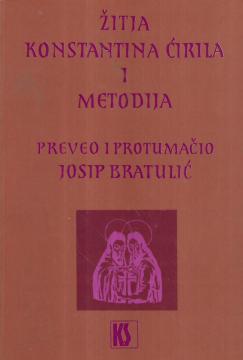
Žitja Konstantina Ćirila i Metodija i druga vrela

Žitja Konstantina Ćirila i Metodija i druga vrela

The basic texts for studying the life and works of Constantine Cyril and Methodius are their biographies, or, as we traditionally call them: life. The Life of Constantine Cyril and the Life of Methodius are texts of exceptional historical and literary val

The holy brothers Constantine Cyril and Methodius were born in Thessaloniki (Thessaloniki, Thessaloniki): Methodius around 815, and Constantine, nicknamed Cyril (Cyril) in monasticism, in 826 or 827, in the family of a high-ranking military official, close to Emperor Leo. Thessaloniki was an important and large city in their time: it is the second largest in the Eastern Roman Empire (Byzantium) because it has a prominent place in its defense since it was threatened by frequent barbarian migrations and invasions. Slavs settled along the walls of Thessaloniki, who already came to the city in the 9th century and became its citizens.

From the index:

Foreword The life of Konstantin Cyril Life of Methodius Italian legend Afterword to the Slavic translation of the Holy Scriptures Proclamation of the Holy Gospel Kudos to Ćiril the Philosopher Eulogy to Cyril and Methodius Črnorizac Hrabar, About literates Alphabetical prayer Hrvatski-Lagolian services of St. Cyril and Methodius Beram breviary Breviary of Pope Moor The second breviary from Novlja - Himan

Translation
Josip Bratulić
Editor
Josip Bratulić
Dimensions
19 x 13 cm
Pages
199
Publisher
Kršćanska sadašnjost, Zagreb, 1992.
 
Latin alphabet. Paperback.
Language: Croatian.

No copies available

The last copy was sold recently.

 

Are you interested in another book? You can search the offer using our search engine or browse books by category.

You may also be interested in these titles

Vjesnik Hrvatskoga arheološkoga društva, sv III. / 1898

Vjesnik Hrvatskoga arheološkoga društva, sv III. / 1898

Josip Brunšmid, Vjekoslav Klaić, Fran Bulić, Emilij Laszowski, Luka Jelić

The third volume of "Vjesnik" for 1898 contains genealogical and historical contributions on the Croatian nobility, archaeological and epigraphic studies, ethnological and military-topographic sketches, and a report on the work of the historical society.

Hrvatsko arheološko društvo, 1899.
Croatian. Latin alphabet. Hardcover.
32.56
Srednjovjekovni statut grada Budve

Srednjovjekovni statut grada Budve

With a foreword by the translator Nikola Vučković.

Turistički savez - Budva, 1970.
Croatian. Latin alphabet. Hardcover.
14.56
Starohrvatska seoska zajednica

Starohrvatska seoska zajednica

Miho Barada

In his work Starohrvatska seoska zajednica (The Old Croatian Village Community) (1957), Miho Barada analyzes the social and agrarian organization of early medieval Croatian villages, their institutions, ownership relations, and common land based on origin

Jugoslavenska akademija znanosti i umjetnosti (JAZU), 1957.
Croatian. Latin alphabet. Paperback.
10.00
Hram i loža

Hram i loža

Michael Baigent, Richard Leigh

Although considered controversial by historians and often criticized as speculative and lacking solid evidence, the book is indispensable and extremely influential – it directly inspired Dan Brown's "The Da Vinci Code" and the entire genre of esoteric lit

Stari grad, 2005.
Croatian. Latin alphabet. Hardcover.
17.22 - 17.28
Hrvatski vladari 1-5.

Hrvatski vladari 1-5.

Neven Budak
Večernji list, 2012.
Croatian. Latin alphabet. Paperback.
The book consists of 5 volumes
12.34 - 15.32
Srednjevekovna srpska država: izabrani izvori

Srednjevekovna srpska država: izabrani izvori

Sima Ćirković

"The Medieval Serbian State - Selected Sources" is a school collection of primary historical sources for teaching medieval Serbian history in secondary schools in Yugoslavia.

Školska knjiga, 1959.
Croatian. Latin alphabet. Paperback.
6.74