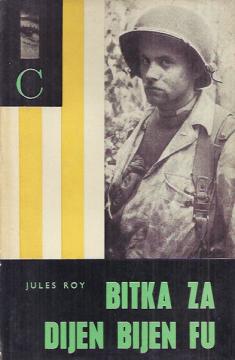
Bitka za Dijen Bijen Fu
Rare book

Bitka za Dijen Bijen Fu

Jules Roy

The Vietnamese siege of the French military base at Điện Biên Phủ was the decisive battle of the Indochina War, sealing French colonial rule in Indochina. After the defeat in this battle, the French withdrew from this region forever.

France's war with the anticolonial Communist-led Vietminh insurgency climaxed in the bloody battle for the valley of Dienbienphu. The Vietminh's victory put the 17 million people of North Vietnam under Communist rule and would, in two years, induce America's attempt to save South Vietnam-without heeding the French army's catastrophic defeat. That defeat, former French soldier Jules Roy explains, occurred not because of a shortage of arms or troops, but more important, less tangible reasons. Hungry for a textbook victory, the French military command occupied the valley in a plan to lure the Vietminh down from the hills to destroy them with supposedly superior artillery. Roy vividly shows how French political infighting in Paris and rivalry in the high command left a few romantic professional officers and soldiers of the French Expeditionary Corps and the Foreign Legion to be surrounded and then overwhelmed by totally dedicated and resourceful enemy forces. Roy also profiles Vietminh soldiers and commanders and how they ended over eighty years of French colonial rule in North Vietnam. 16 pages of black-and-white photographs add to a "moving and dramatic" (New York Times Book Review) account of the battle that led to America's involvement the Vietnam War.

Original title
La bataille de Dien Bien Phu
Translation
Marija Eker-Manolić
Editor
Frane Barbieri
Graphics design
Andre Lušičić
Dimensions
20.5 x 13.5 cm
Pages
402
Publisher
Epoha, Zagreb, 1965.
 
Latin alphabet. Hardcover with dust jacket.
Language: Croatian.

No copies available

The last copy was sold recently.
 

Are you interested in another book? You can search the offer using our search engine or browse books by category.

You may also be interested in these titles

Pakao Pacifika 1-2

Pakao Pacifika 1-2

Boris Prikril

A book that has achieved extraordinary success. The reader cannot put it down until he has read it to the end. As if in a film, vividly and dynamically, the most dramatic events of World War II unfold before the reader's eyes.

Znanje, 1985.
Croatian. Latin alphabet. Hardcover with dust jacket.
The book consists of two volumes
4.98
Komunisti Jugoslavije 1919-1979.

Komunisti Jugoslavije 1919-1979.

Pero Morača, Stanislav Stojanović

The book provides an overview of the history of the Communist Party of Yugoslavia (KPJ) from its founding to the late 1970s, emphasizing its role in the revolution, self-government, and construction of Yugoslavia, with an ideologically colored perspective

Eksportpres, 1979.
Serbian. Latin alphabet. Hardcover with dust jacket.
11.98
Opet jaše Ku-klux-klan

Opet jaše Ku-klux-klan

Branko Bucalo

The book is written in a lively and sharp style, which - along with a vivid film of facts - continuously keeps the attention of the reader who likes nonfiction full of twists and a certain cynicism imposed by the topic.

Epoha, 1964.
Croatian. Latin alphabet. Hardcover with dust jacket.
6.745.06
Povijest #18: Poslijeratno doba (1945.-1985.)

Povijest #18: Poslijeratno doba (1945.-1985.)

Europapress holding, 2008.
Croatian. Latin alphabet. Hardcover.
11.24
Turska noć

Turska noć

Philippe Videlier

The crime against the Armenians is only coming to light today. After almost a century, the tragedy of a nation, the indifference of the Constantinople authorities, the media cover-up and the turning of the international community's head are unfolding befo

Durieux, 2010.
Croatian. Latin alphabet. Hardcover with dust jacket.
11.42
Svetozar Pribićević u opoziciji (1928-1936)

Svetozar Pribićević u opoziciji (1928-1936)

Ljubo Boban

One of the essential features of Pribićević's politics is the continuous process of transformation and improvement of attitudes and concepts. He followed the circumstances around him, in the country and abroad, and often reacted directly to them, expresse

Institut za hrvatsku povijest, 1973.
Croatian. Latin alphabet. Hardcover.
7.54 - 7.86