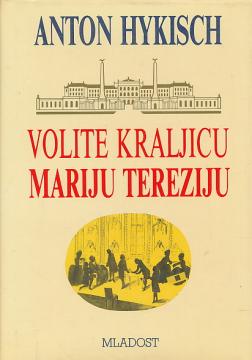
Volite kraljicu Mariju Tereziju

Volite kraljicu Mariju Tereziju

Anton Hykisch

This historical prose follows the story of the famous Austrian empress Maria Theresa. The work is the first edition of the Gama library.

Maria Theresa, the Austrian empress who ruled from 1740 to 1780, left a deep mark on history. Here are some of the ways she has made an impact:

  • Modernization and reforms: Maria Theresa carried out numerous reforms to modernize the Habsburg Monarchy. This includes reforms in the fields of education, military, judiciary and administration.
  • Centralization of power: The empress strengthened the central government and reduced the power of the nobility. Its reforms increased the efficiency of the administration and enabled better control over the territory.
  • Economic reforms: Maria Theresa encouraged agriculture, trade and industry. It improved the infrastructure, built roads and encouraged the development of mining.
  • Education: The empress founded numerous schools and promoted education. Her support for education contributed to the progress of society.
  • Succession: Her son, Emperor Joseph II., continued her reforms and expanded them. Their legacy left a lasting impact on Europe.

In short, Maria Theresa was a strong ruler who modernized her empire and left a deep mark on European history.

Original title
Milujte kralovnu
Translation
Anka Katušić Balen
Editor
Zvonimir Majdak
Graphics design
Fadil Vejzović
Dimensions
20.5 x 14 cm
Pages
495
Publisher
Mladost, Zagreb, 1989.
 
Latin alphabet. Hardcover with dust jacket.
Language: Croatian.

No copies available

The last copy was sold recently.
 

Are you interested in another book? You can search the offer using our search engine or browse books by category.

You may also be interested in these titles

Brodkovski odvjetnik: Slika iz savremenog moravskog života

Brodkovski odvjetnik: Slika iz savremenog moravskog života

Vaclav Beneš Šumavsky

"The Brodkov Lawyer" by Václav Beneš Šumavsky is a realistic novel about a lawyer, social conditions, morality and everyday life in Moravia. Popular Czech fiction in Croatian translation.

Tisak i naklada knjižare Janka Dujaka, 1894.
Croatian. Latin alphabet. Paperback.
9.38
Start Edmunda Sulime

Start Edmunda Sulime

Zygmunt Nowakowski

The novel follows the young Edmund Sulima, who, in interwar Poland full of ideals, enters the world of theater and art, facing the difficulties of theatrical life, social intrigues, loves, and disappointments.

Savremena biblioteka, 1939.
Croatian. Latin alphabet. Hardcover with dust jacket.
9.56
Seljaci III: Proljeće

Seljaci III: Proljeće

Władysław Stanisław Reymont

The third part of the epic tetralogy The Peasants. Spring brings the awakening of nature, but also new conflicts in the village of Lipce: the culmination of a love triangle, family drama and social tensions. The continuation of Nobel's epic of Polish peas

Matica hrvatska, 1934.
Croatian. Latin alphabet. Hardcover.
7.32 - 23.54 (set)
U žutoj kući

U žutoj kući

Ksaver Šandor Gjalski

Gjalski's novel In the Yellow House (1914) exposes provincial everyday life: masks of politeness, quiet ambitions, and gentle, ironic clashes between desire and duty, told with fine psychology and style. Rare antiquarian edition.

Vlastita naklada, 1914.
Croatian. Latin alphabet. Paperback.
6.42
Germanin ideal

Germanin ideal

Marie Montal

Young Germaine lives a life filled with high ideals of love, faith, and purity. The novel follows her struggle between her noble dreams and the realities of life in French society at the end of the 19th century.

Tisak i naklada Antuna Scholza, 1905.
Croatian. Latin alphabet. Hardcover.
8.32
Savremena historija: Brijest na bedemu

Savremena historija: Brijest na bedemu

Anatole France

The first part of the famous tetralogy Contemporary History, published by French Nobel Prize winner Anatole France in 1897. A classic work of European realism and satire from the turn of the century.

Hrvatski štamparski zavod d.d., 1922.
Croatian. Latin alphabet. Paperback.
9.36