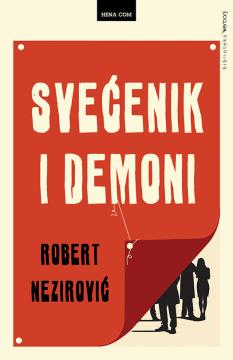
Svećenik i demoni

Svećenik i demoni

Robert Nezirović

When a police inspector receives news of the brutal murder of a priest, and then goes out into the field and finds a bracelet with an engraved name, one has no choice but to think that we are at the beginning of an intriguing crime story.

But just as some names can be both female and male, some novels are not what they appear to be at the first sentence. Robert Nezirović's novel is energetic and dynamic, as the genre requires, but who brought it is not in the foreground here, although, don't worry, you will find out in the end.

A successful neurosurgeon, a politician on a downward trajectory, a representative of Zagreb's underground and an architect once sat together in the school desks of the coastal city, and now, each of them from their complicated lives, will briefly go to the funeral of a schoolmate, a murdered priest. While the investigation is going on in the background, each of the characters, including the inspector who leads it, struggles with their private and professional setbacks, and the intertwining of their stories opens up numerous neuralgic themes of turbulent reality. And while one bracelet is looking for its owner, pieces of the well-known bilge are torn from the whirlwind of the characters' lives - the combination of politics and the mafia, political turbulence, homophobia, drugs and prostitution - along with marital shipwrecks, illnesses, loneliness, and even an obsession with a pop star.

Through the destinies of the characters, Nezirović scans various layers of society, and in this one can clearly feel the criticism towards deviations, immorality, and corruption. The characters are not just figures that depict society, but are carefully characterized with their inner and outer demons that come to light when we least expect it.

Editor
Jagna Pogačnik, Nermina Husković
Graphics design
Jasna Goreta
Dimensions
21.5 x 14 cm
Pages
239
Publisher
Hena Com, Zagreb, 2023.
 
Latin alphabet. Hardcover with dust jacket.
Language: Croatian.
ISBN
978-9-53259-456-0

One copy is available

Condition:Unused
 

Are you interested in another book? You can search the offer using our search engine or browse books by category.

You may also be interested in these titles

Moskva – Petuški

Moskva – Petuški

Venjedikt Jerofejev

Venedikt Yerofeyev's postmodern prose poem is today considered a classic of new Russian literature. It is compared to Gogol and Kharms for its poetics of absurdity, satire, and metaphysical depth.

LOM, 217.
Serbian. Cyrillic alphabet. Paperback.
11.24
Koncert za tequilu i apaurin

Koncert za tequilu i apaurin

Edo Popović

A short novel by Edo Popović, one of the most important Croatian prose writers of the 1990s and 2000s. The book is part of Popović's "Zagreb Cycle" – a critique of transition without pathos, but through absurdity and grotesqueness.

Meandar, 2003.
Croatian. Latin alphabet. Paperback.
3.26
Život je negdje drugdje

Život je negdje drugdje

Milan Kundera

Jaromil, a young poet raised by a possessive mother, seeks a "real life" in poetry and revolution. His lyrical youth, love, and idealism lead him into conformity and betrayal of intimate relationships – he dies young and unfulfilled.

Znanje, 1979.
Croatian. Latin alphabet. Hardcover with dust jacket.
4.86
Provincijalac

Provincijalac

Momo Kapor

As much as Foliranti is a story about Kapor's student days in Belgrade in the late fifties, Provincial is a book that evokes memories of his childhood in Sarajevo, where the author spent the first years of his life.

Znanje, 1984.
Serbian. Latin alphabet. Paperback.
5.32
Svjetlost se ugasila

Svjetlost se ugasila

Rudyard Kipling

The first novel by English Nobel Prize winner Rudyard Kipling (1865–1936), first published in Lippincott's Monthly Magazine (happy ending variant), and then in a book version with a tragic ending.

Zora, 1957.
Croatian. Latin alphabet. Hardcover with dust jacket.
5.42
Budenbrokovi

Budenbrokovi

Thomas Mann

The Buddenbrooks is not just a family chronicle – it is a profound, melancholic fresco of how time and change inexorably creep into the core of a respectable bourgeois family, bringing with them a downfall that is both tragic and inevitable.

Svjetlost, 1961.
Serbian. Latin alphabet. Hardcover.
The book consists of two volumes
11.54