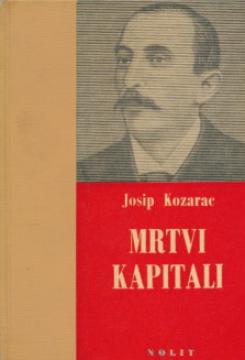
Mrtvi kapitali

Mrtvi kapitali

Josip Kozarac

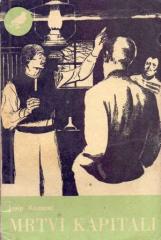
The very title of the novel tells us how Kozarac was preoccupied with the uncultivated, dead land that is waiting for a man, a hardworking peasant, who will cultivate it. He called it "dead capital".

The basis of the plot is the fate of two sisters and the story of love. Through the plot of the novel, Josip Kozarac wanted to show the contrast between the village and the city. According to him, the village is described as a place where sincere feelings, happiness and uncorruption prevail, while the city is a place of idleness and decadence.

Editor
Bogdan Ćurčin
Illustrations
Sreten Grujić
Graphics design
Lj. Pavićević Fis
Dimensions
17 x 12 cm
Pages
158
Publisher
Nolit, Beograd, 1969.
 
Latin alphabet. Hardcover.
Language: Serbian.

No copies available

The last copy was sold recently.
 

Are you interested in another book? You can search the offer using our search engine or browse books by category.

You may also be interested in these titles

Među svjetlom i tminom

Među svjetlom i tminom

Josip Kozarac

"Between Light and Darkness" is a short story by Josip Kozarac in which the author depicts a person's inner struggle between moral values ​​(light) and weakness, temptation, and wrong decisions (darkness).

Glas Slavonije, 1974.
Croatian. Latin alphabet. Hardcover.
4.80 - 4.99
Mrtvi kapitali

Mrtvi kapitali

Josip Kozarac
Zora, 1962.
Croatian. Latin alphabet. Paperback.
1.32 - 2.16
Zbogom Slavonijo 2

Zbogom Slavonijo 2

Josip Kozarac
Privlačica, 1987.
Croatian. Latin alphabet. Paperback.
3.99
Vidjet ćeš kad odrasteš

Vidjet ćeš kad odrasteš

Luca Kozina

You'll See When You Grow Up by Luce Kozine is a striking collection of stories that, from a child's perspective, speaks about the traumas of growing up, the hypocrisy of adults, and the hope that can still save us.

Fraktura, 2024.
Croatian. Latin alphabet. Hardcover with dust jacket.
14.54
Moskva – Petuški

Moskva – Petuški

Venjedikt Jerofejev

Venedikt Yerofeyev's postmodern prose poem is today considered a classic of new Russian literature. It is compared to Gogol and Kharms for its poetics of absurdity, satire, and metaphysical depth.

LOM, 217.
Serbian. Cyrillic alphabet. Paperback.
11.24
Pažnja

Pažnja

Alberto Moravia

Francesco Merighi returns to Rome after 9 years abroad. In order to write an "authentic" novel, he keeps a diary of his life with his wife and their daughter Babe. He obsessively analyzes lies in relationships, the temptation of

Otokar Keršovani, 1966.
Croatian. Latin alphabet. Hardcover.
3.96