Contemporary philosophy • Philosophy of law
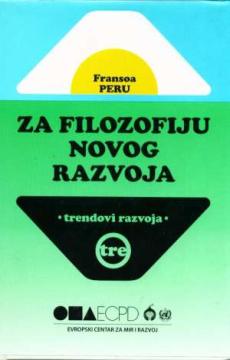
Za filozofiju novog razvoja
Francois Perroux
For the philosophy of new development, the author François Peru represents an important work that deals with the economic and social aspects of development.
This book explores the concepts of growth, development and progression, and offers theoretical elaborations on the economic independence of nations, inflation, capitalism and other relevant concepts.
In this provocative and interdisciplinary book, the author shows that emotions are not universal biological constants, but change across time, cultures, and social contexts – and they are precisely those that are crucial in shaping the history of humanity
Školska knjiga, 2023.
Croatian. Latin alphabet. Hardcover with dust jacket.
21.36 €
Philosophy of language • Anthropology • Culturology • Contemporary philosophy • Sociology
In Culture and Communication, Edmund Leach explores social relations through language, rituals, and symbols. He connects anthropology with communication theory, showing culture as a system of meaning that shapes human behavior.
The book has become a classic because it accurately describes the world of Amazon, Uber, Netflix, and TikTok thirty years in advance. Ritzer does not curse fast food, but warns that if the whole of society turns into McDonald’s, we will remain full but hu
In this provocative essay, Sloterdijk intervenes in the heated debate of the 1980s about modernism and postmodernism. A short, sharp text – essential for understanding Sloterdijk's early approach to aesthetics, media and the crisis of modernity.
Svetovi, 1988.
Serbian. Latin alphabet. Paperback with dust jacket.
Girardi Karšulin not only reconstructs the thought, but also interprets its relevance for contemporary philosophy, highlighting Petrić's pluralism and critical spirit.
Institut za povijesne znanosti, 1988.
Croatian. Latin alphabet. Paperback.
6.724.70 €
Interviews • Autobiographies and Memoirs • Political philosophy • Contemporary philosophy
A book of interviews in which Kołakowski retrospectively describes his life and intellectual journey through the turbulent 20th century – from pre-war Poland, through Nazi occupation, Stalinism, revisionist Marxism, to exile in the West.