Istočna Slavonija: Stanovništvo i naselja

Istočna Slavonija: Stanovništvo i naselja

Mirko Marković

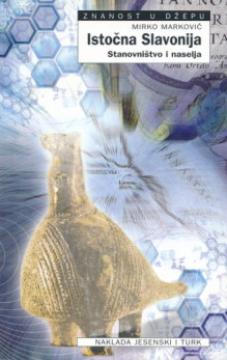
In the book, academician Mirko Marković briefly analyzes the origin of settlements and the development of the population in Eastern Slavonia, based on the data he collected during his rich and decades-long research of this area.

The history of Eastern Slavonia, i.e. the area east of Osijek, Đakovo and Županja, goes back to the Neolithic period, when the first settlements were established in the area of ​​Vinkovci, Osijek, Vukovar and Vučedol. In the book, we briefly get to know the characteristics of the earliest cultures, including the Vučedol culture, from which the most recognizable archaeological find from that area originates - a ceramic vessel in the shape of a dove. Then the periods of Roman rule in Pannonia, the immigration of Croats to Pannonia and the establishment of Pannonian Croatia and the Kingdom of Croatia, Turkish rule and the settlement of the Šokacs and Bunjevics were covered. The recent history of the Iloc, Vukovar, Dal, Osijek, Vinkovac, Đakovo and Župan areas is specially covered. Concise and concise in its approach, the book also abounds with many interesting facts - about the beginnings of grapevine cultivation, legends, autochthonous families, the origin of the names of villages and towns and urban areas... Prof. Mirko Marković, Ph.D., worked at the Institute of Ethnology at HAZU for forty years and managed it for twenty years. He has been a member of HAZU since 1980. He published around two hundred professional and scientific works, including a dozen more voluminous books. He mostly studied the past of Croatian settlements, old maps and plans, and population migrations. The same library also published his studies Ličani through the past, Croatia on old maps, Hrvatsko zagorje. Population and settlements.

Editor
Mišo Nejašmić
Dimensions
18 x 11 cm
Pages
127
Publisher
Jesenski i Turk, Zagreb, 2003.
 
Latin alphabet. Paperback.
Language: Croatian.
ISBN
978-9-53222-123-7

No copies available

The last copy was sold recently.
 

Are you interested in another book? You can search the offer using our search engine or browse books by category.

You may also be interested in these titles

Važnost nalaza ranosrednjovjekovnog koplja u Varaždinu

Važnost nalaza ranosrednjovjekovnog koplja u Varaždinu

Željko Tomičić
Jugoslavenska akademija znanosti i umjetnosti, 1968.
Croatian. Latin alphabet. Paperback.
4.98
Hrvatsko proljeće

Hrvatsko proljeće

Miko Tripalo

The Croatian Spring is not only a chronicle of the events of 1971, but also a suggestive presentation of the political conditions of Yugoslavia in the post-war period. These testimonies come from the pen of a man who really tried to break the shackles of

Globus, 1990.
Croatian. Latin alphabet. Hardcover with dust jacket.
11.58
Stjepan Radić

Stjepan Radić

The Stjepan Radić exhibition catalogue, published in 1991 on the occasion of the exhibition at the Croatian History Museum in Zagreb, is dedicated to the life and work of Stjepan Radić (1871–1928), a key figure in Croatian politics and the founder of the

Hrvatski povijesni muzej, 1991.
Croatian. Latin alphabet. Paperback.
6.42
Zagreb tisuću devetsto četrdeset prve

Zagreb tisuću devetsto četrdeset prve

Ivan Šibl

"Zagreb one thousand nine hundred and forty-first" is not only a historical overview of events, but at the same time it is also a book in which the author vividly and directly outlined dozens of portraits. A book that is at the same time a historiographic

Naprijed, 1967.
Croatian. Latin alphabet. Hardcover with dust jacket.
7.98
Tvornica olovaka u Zagrebu : 40 godina rada i razvoja 1937 - 1977

Tvornica olovaka u Zagrebu : 40 godina rada i razvoja 1937 - 1977

TOZ, tvornica olovaka, školskog i kancelarijskog pribora, 1977.
Croatian. Latin alphabet. Hardcover.
14.98
Jugoslavenske vlade u izbjeglištvu 1941-1943

Jugoslavenske vlade u izbjeglištvu 1941-1943

Bogdan Krizman, Branko Petranović

A two-volume work that documents the activities of Yugoslav governments in exile during World War II. The study represents a significant contribution to the study of the history of political processes during World War II.

Globus, 1981.
Croatian. Latin alphabet. Hardcover with dust jacket.
The book consists of two volumes
12.99