Istočna Slavonija: Stanovništvo i naselja

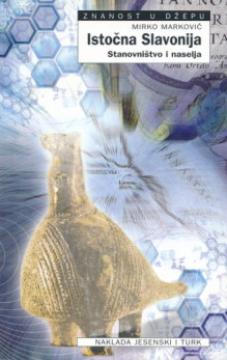
Istočna Slavonija: Stanovništvo i naselja

Mirko Marković

In the book, academician Mirko Marković briefly analyzes the origin of settlements and the development of the population in Eastern Slavonia, based on the data he collected during his rich and decades-long research of this area.

The history of Eastern Slavonia, i.e. the area east of Osijek, Đakovo and Županja, goes back to the Neolithic period, when the first settlements were established in the area of ​​Vinkovci, Osijek, Vukovar and Vučedol. In the book, we briefly get to know the characteristics of the earliest cultures, including the Vučedol culture, from which the most recognizable archaeological find from that area originates - a ceramic vessel in the shape of a dove. Then the periods of Roman rule in Pannonia, the immigration of Croats to Pannonia and the establishment of Pannonian Croatia and the Kingdom of Croatia, Turkish rule and the settlement of the Šokacs and Bunjevics were covered. The recent history of the Iloc, Vukovar, Dal, Osijek, Vinkovac, Đakovo and Župan areas is specially covered. Concise and concise in its approach, the book also abounds with many interesting facts - about the beginnings of grapevine cultivation, legends, autochthonous families, the origin of the names of villages and towns and urban areas... Prof. Mirko Marković, Ph.D., worked at the Institute of Ethnology at HAZU for forty years and managed it for twenty years. He has been a member of HAZU since 1980. He published around two hundred professional and scientific works, including a dozen more voluminous books. He mostly studied the past of Croatian settlements, old maps and plans, and population migrations. The same library also published his studies Ličani through the past, Croatia on old maps, Hrvatsko zagorje. Population and settlements.

Editor
Mišo Nejašmić
Maße
18 x 11 cm
Seitenzahl
127
Verlag
Jesenski i Turk, Zagreb, 2003.
 
Latein Schrift. Taschenbuch.
Sprache: Kroatisch.
ISBN
978-9-53222-123-7

Im Angebot sind keine Exemplare vorhanden

Das letzte Exemplar wurde kürzlich verkauft.
 

Interessieren Sie sich für ein anderes Buch? Sie können das Angebot über unsere Suchmaschine suchen und finden oder Bücher nach Kategorien durchsuchen.

Diese Titel könnten Sie auch interessieren

Drinovci na dlanu ruke Njegove: Monografija naselja i župe

Drinovci na dlanu ruke Njegove: Monografija naselja i župe

The monograph "Drinovci in the Palm of His Hand" is the result of years of work by 23 authors and co-authors, mostly from Drinovci. This wonderful work represents the most comprehensive and beautiful publication about a Herzegovinian village and parish to

Crkva na kamenu, 2022.
Kroatisch. Latein Schrift. Hardcover.
76,24
Predturska povijest Našica

Predturska povijest Našica

Julije Jančula

The book about the pre-Turkish history of Našice, written by abbot Julije Jančula, deals exclusively with that specific period of Slavonian and Našić history.

Zavičajni muzej Našice, 1996.
Kroatisch. Latein Schrift. Taschenbuch.
4,88
Hrvatski duh Alke: simbolika i filozofija hrvatske povijesti

Hrvatski duh Alke: simbolika i filozofija hrvatske povijesti

Petar Vučić

Through Sinj's Alka, the entirety of the Croatian ethnic and ethical being is encompassed.

Consilium, 1998.
Kroatisch. Latein Schrift. Taschenbuch.
5,62
Topografično-povijesne crte slobodnog kraljevskog grada Križevca

Topografično-povijesne crte slobodnog kraljevskog grada Križevca

Kvirin Vidačić

The book "Topographical-historical contours of the free royal city of Križevac" by Kvirin Vidačić is a reprint from 1886.

Matica hrvatska, 1993.
Kroatisch. Latein Schrift. Hardcover.
17,22
Korespondencija Stjepana Radića

Korespondencija Stjepana Radića

Bogdan Krizman
Institut za hrvatsku povijest, 1973.
Kroatisch. Latein Schrift. Hardcover.
Das Buch besteht aus zwei Bänden
9,98
Hrvatski narodni vladari od god. 620.–1102.

Hrvatski narodni vladari od god. 620.–1102.

Mate Sagher

A pioneering attempt at a systematic presentation of Croatian political history from the settlement of Croats to the conclusion of a personal union with Hungary. Segher chronologically traces the development of Croatian statehood, relying on the sources a

Dionička tiskara, 1903.
Kroatisch. Latein Schrift. Taschenbuch.
14,76