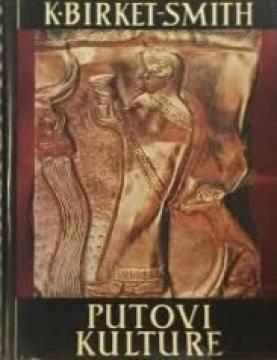
Putovi kulture

Putovi kulture

Kaj Birket-Smith

The Paths of Culture by Danish ethnologist Kaj Birket-Smith depicts the development of human cultures from prehistory to the modern era and explains how the environment, economy, and mutual contacts shape societies and their way of life.

The Paths of Culture by Danish ethnologist Kaj Birket-Smith is one of the most famous popular science works in the field of ethnology and cultural anthropology. The author attempts to explain how human cultures have developed from the earliest communities to complex civilizations, emphasizing that cultural development is not the same in all parts of the world nor does it follow a single path. Instead, different natural conditions, economic activities, social relations, and historical circumstances create a great diversity of human communities.

The book addresses fundamental questions of cultural evolution, the way of life of hunters and gatherers, the development of animal husbandry and agriculture, the emergence of settlements, trade, and the first states. Birket-Smith describes the customs, beliefs, art, technology, and social organization of numerous peoples from all continents, using examples from ethnographic research to show similarities and differences between cultures. He pays special attention to cultural contacts and the spread of ideas, emphasizing that cultures do not develop in isolation, but through the constant exchange of knowledge, objects, and customs.

The value of the publication is further enhanced by its equipment: the book contains 351 images in the text and 6 geographical maps on art paper, which enable the reader to more easily follow cultural areas, migrations and the development of human communities. The work is written in an accessible style and is intended for a wide range of readers. Although some of the author's interpretations reflect the insights of anthropology in the first half of the 20th century and are now partly outdated, the book still has great value as an overview of the development of ethnological thought and as an introduction to understanding the cultural diversity of humanity.

Original title
Geschichte der Kultur
Translation
Zvonimir Golob
Editor
Oleg Mandić
Graphics design
Valerija Pavić
Dimensions
22 x 15 cm
Pages
539
Publisher
Matica hrvatska, Zagreb, 1960.
 
Latin alphabet. Hardcover with dust jacket.
Language: Croatian.

One copy is available

Condition:Used, good condition (visible signs of use)
Damages or inconvenience notice:
  • The cover is missing
  • Traces of patina
  • Library stamp
 

Are you interested in another book? You can search the offer using our search engine or browse books by category.

You may also be interested in these titles

Vikinzi

Vikinzi

Tony Allan

This book is a richly illustrated introduction to an exceptionally interesting people, known for their belligerence and conquering tendencies, but at the same time capable of enchanting craftsmanship and a mythological view of the world.

24 sata, 2001.
Croatian. Latin alphabet. Hardcover.
6.004.50
Otisci bogova: Potraga za početkom i krajem

Otisci bogova: Potraga za početkom i krajem

Graham Hancock

Hancock's evidence reveals not only the clear footprints of an unknown civilization that flourished during the last ice age, but also the terrifying truth about the scale of the catastrophe that wiped out almost all traces of it.

Stari grad, 2002.
Croatian. Latin alphabet. Hardcover.
19.2215.46 - 19.3619.28
Prije potopa: Dokaz da je biblijski potop bio stvaran događaj

Prije potopa: Dokaz da je biblijski potop bio stvaran događaj

Ian Wilson

British historian Ian Wilson (known for his books on the Shroud of Turin and Jesus) offers the most thorough defense of the thesis that the biblical flood was a real historical event, not just a myth, in his work Before the Flood.

Stari grad, 2007.
Croatian. Latin alphabet. Hardcover.
16.22 - 16.28
Uvod u podunavsko pismo

Uvod u podunavsko pismo

Harald Haarman

Introduction to the Danubian Script by Harald Haarmann (2010) is the first systematic introduction to the oldest writing system in Europe – the Old European or Danubian script (c. 5300–3200 BC), which emerged within the framework of the Danubian Civilizat

Akademska knjiga, 2022.
Serbian. Latin alphabet. Hardcover.
20.00
Izabrani Plinijevi listovi

Izabrani Plinijevi listovi

Plinije Stariji

Anthology of Latin Fragments of Pliny the Elder with Croatian Explanations (Golik, 1909) presents ancient views on nature, man and the world, with brief comments for understanding and teaching.

Troškom i nakladom Kr. hrv.-slav.-dalm. zemalj. vlade, 1909.
Latin. Latin alphabet. Paperback.
9.32
Neolit i eneolit u Slavoniji

Neolit i eneolit u Slavoniji

Stojan Dimitrijević, Bogdan Brukner, Nikola Tasić, Vladimir Mirosavljević

The proceedings of the Symposium "Neolithic and Eneolithic in Slavonia", held in Vukovar on 4–5 June 1966, bring together contributions on Neolithic and Eneolithic cultures, material finds and regional connections.

Gradski muzej Vukovar, 1969.
Croatian. Latin alphabet. Paperback with dust jacket.
13.54