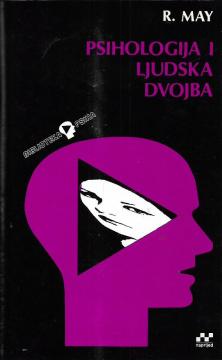
Psihologija i ljudska dvojba

Psihologija i ljudska dvojba

Rollo May

Whether reflecting on war, psychology, or the ideas of existentialist thinkers such as Sartre and Kierkegaard, Dr. May everywhere expands our view of how humans can develop creatively in the human predicament.

Translation
Anita Sujoldžić
Editor
Mirjana Dobrović, Muradif Kulenović
Graphics design
Ratko Janjić-Jobo
Dimensions
23 x 15 cm
Pages
256
Publisher
Naprijed, Zagreb, 1980.
 
Latin alphabet. Hardcover with dust jacket.
Language: Croatian.

No copies available

The last copy was sold recently.
 

Are you interested in another book? You can search the offer using our search engine or browse books by category.

You may also be interested in these titles

Jedno ljeto s Pascalom

Jedno ljeto s Pascalom

Antoine Compagnon
Tim press, 2021.
Croatian. Latin alphabet. Paperback.
10.98
Jastvo i drugi

Jastvo i drugi

Ronald Leing
Bratstvo-Jedinstvo, 1989.
Croatian. Latin alphabet. Paperback with dust jacket.
7.62
Stranac

Stranac

Albert Camus

The Stranger is a novel by French writer and philosopher Albert Camus. Published in 1942, it is one of the most significant novels in twentieth-century French literature and one of the best literary depictions of the absurdity of human existence.

Znanje, 1980.
Croatian. Latin alphabet. Paperback.
5.62
Čovjek: Njegova priroda i njegov položaj u svijetu

Čovjek: Njegova priroda i njegov položaj u svijetu

Arnold Gehlen

Arnold Gehlen's main work "The Man" has been the central work of philosophical anthropology since its publication in 1940.

Svjetlost, 1990.
Croatian. Latin alphabet. Hardcover.
12.28
Hegelova ontologija i teorija povijesnosti

Hegelova ontologija i teorija povijesnosti

Herbert Marcuse

In this work, Marcuse deals with the interpretation of Hegel's philosophy through the prism of ontology and historicity, trying to connect it with questions that were relevant to existentialism and phenomenology in the interwar period.

Veselin Masleša, 1981.
Croatian. Latin alphabet. Paperback.
13.42
Imati ili biti?

Imati ili biti?

Erich Fromm

Fromm distinguishes between two ways of life: “having” – focused on possession and control, and “being” – focused on experience, love and authenticity. He calls for a shift towards “being” for true happiness.

Naprijed, 1986.
Croatian. Latin alphabet. Hardcover with dust jacket.
9.96