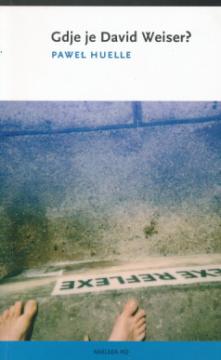
Gdje je David Weiser

Gdje je David Weiser

Pawel Huelle

"Where's David Weiser?" is a novel by Pawel Huelle that, after a three-year 'bunker' in Poland, was published in 1987 and was quickly declared the "novel of the decade" by local critics, as well as a national classic.

Where is it? or maybe Who is it? a boy who turns the forests around post-war Gdańsk and the lives of his schoolmates into a stage of dangerous games - in which the fate of entire nations, but also of each one of us, is reflected - is only the first, initial question posed by its author in this extraordinary novel. All that come will then be posed by the reader, in turn discovering once again that no answer is more valuable than the path that led to it.

The novel thematizes the growing up of a group of boys in the turbulent post-war period and is another confirmation that childhood is an inexhaustible source of inspiration and the starting point of artistic creation, with the thematization of which authors often reach their creative peaks.

Translation
Ivana Vidović Bolt
Editor
Roman Simić
Illustrations
Jasenko Rasol
Graphics design
Igor Kuduz
Dimensions
20 x 12.5 cm
Pages
249
Publisher
Naklada MD, Zagreb, 2005.
 
Latin alphabet. Paperback.
Language: Croatian.
ISBN
978-9-53217-096-2

One copy is available

Condition:Used, excellent condition
Specificity of this instance:
Dedication
 

Are you interested in another book? You can search the offer using our search engine or browse books by category.

You may also be interested in these titles

Kockar

Kockar

Fjodor Mihajlovič Dostojevski

The novel "The Gambler" (1866) occupies an exceptional place in Dostoevsky's work. Although the idea for this novel supposedly matured for a full three years, Dostoevsky dictated it almost in his breath, in just twenty-seven days.

August Cesarec, 1986.
Croatian. Latin alphabet. Paperback.
5.32
Gosposvetsko polje

Gosposvetsko polje

Prežihov Voranc
Zora, 1951.
Croatian. Latin alphabet. Paperback.
1.50
Glasovi u kući

Glasovi u kući

Pearl S. Buck
Rad, 1971.
Serbian. Latin alphabet. Hardcover.
3.99
Djeca ljeta

Djeca ljeta

Robert Sabatier

The pisano has its own meaning, it has many sensibilities, a poet's disposition is also available and the pisca can be re-entered. Djeca ljeta se ne čitaju, čitalac se šeta kroz roman kao kroz prekrasnu aleju od čempresa.

Otokar Keršovani, 1982.
Croatian. Latin alphabet. Hardcover with dust jacket.
3.98
I ne reče ni reči

I ne reče ni reči

Heinrich Böll

In Boll's novels, one of the central themes is the attempt to preserve basic moral values ​​in a time of terror, as well as in a period of material prosperity and corruption.

Svjetlost, 1965.
Serbian. Latin alphabet. Paperback.
3.22 - 3.98
Ujakov san / Poniženi i uvrijeđeni

Ujakov san / Poniženi i uvrijeđeni

Fjodor Mihajlovič Dostojevski

Both works reflect Dostoevsky's early phase, with a focus on social criticism, psychological analysis and moral dilemmas, foreshadowing the themes of his later masterpieces.

Znanje, 1982.
Croatian. Latin alphabet. Hardcover.
13.269.95