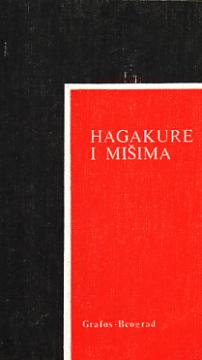
Hagakure i Mišima

Hagakure i Mišima

Hagakure is, in fact, a collection of thoughts of the samurai priest-hermit Jocho Yamamoto. These thoughts of the samurai were transferred to paper by the young samurai Tsuramoto Tashiro (1710).

No one cultivated friendship with a single book as loyally and passionately as Mishima did with the book Hagakure by Joko Yamamoto (1659-1719). That strange book is Mishima's "spiritual leader", the basis of every moral quality. From an early age, she teaches him freedom and passion, reveals to him that the way of the samurai is death.

Hagakure? In the beginning, the name of the book was The Collection of Thoughts of Teacher Hagakure, in seven volumes, and we present it here under today's abbreviated name Hagakure (hidden in the leaves).

Original title
Hagakure
Translation
Srbislava Elezović Lazić
Editor
Vito Marković
Graphics design
Voja Milić
Dimensions
19 x 11.5 cm
Pages
5000
Publisher
Grafos, Beograd, 1986.
 
Latin alphabet. Paperback.
Language: Serbian.

No copies available

The last copy was sold recently.


Are you interested in another book? You can search the offer using our search engine or browse books by category.

You may also be interested in these titles

Kopernikanska mobilizacija i ptolomejsko razoružanje: Ogled iz estetike

Kopernikanska mobilizacija i ptolomejsko razoružanje: Ogled iz estetike

Peter Sloterdijk

In this provocative essay, Sloterdijk intervenes in the heated debate of the 1980s about modernism and postmodernism. A short, sharp text – essential for understanding Sloterdijk's early approach to aesthetics, media and the crisis of modernity.

Svetovi, 1988.
Serbian. Latin alphabet. Paperback with dust jacket.
8.36
Grad sunca

Grad sunca

Tommaso Campanella

The City of the Sun (Latin: Civitas Solis, published in 1623) is a visionary, esoteric, almost mystical utopia, deeply imbued with the Renaissance spirit, Egyptian astrology, and the Christian hope for a perfect society.

Kultura, 1964.
Serbian. Latin alphabet. Hardcover.
7.52
Pravo na laganje

Pravo na laganje

Immanuel Kant, Benjamin Constant

Kant argued that there is no right to lie because telling the truth is an absolute duty, while Constant advocated the possibility of an exception to the duty, arguing that one should lie for the common good, which sparked a famous philosophical debate.

Službeni glasnik, 2008.
Serbian. Latin alphabet. Paperback.
8.36
Što su Česi?: kratki pregled činjenica i pokušaj objašnjenja

Što su Česi?: kratki pregled činjenica i pokušaj objašnjenja

Jan Patočka

In the book before you, Jan Patočka wrote a paradigmatic essay on the Central European identity of a Slavic people.

Durieux, 2000.
Croatian. Latin alphabet. Paperback.
7.746.19
Foucault

Foucault

Gilles Deleuze

Deleuze's Portrait of Foucault (1986) is not a monograph, but a creative "thinking with Foucault." It analyzes the archaeology of knowledge, introducing the concepts of archive, power, subjectification, and "fold" as crucial to Foucault's thought on knowl

Sandorf, 2023.
Croatian. Latin alphabet. Paperback.
11.86