Svećenik i demoni

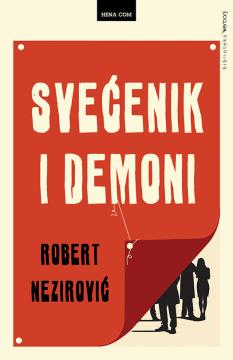
Svećenik i demoni

Robert Nezirović

When a police inspector receives news of the brutal murder of a priest, and then goes out into the field and finds a bracelet with an engraved name, one has no choice but to think that we are at the beginning of an intriguing crime story.

But just as some names can be both female and male, some novels are not what they appear to be at the first sentence. Robert Nezirović's novel is energetic and dynamic, as the genre requires, but who brought it is not in the foreground here, although, don't worry, you will find out in the end.

A successful neurosurgeon, a politician on a downward trajectory, a representative of Zagreb's underground and an architect once sat together in the school desks of the coastal city, and now, each of them from their complicated lives, will briefly go to the funeral of a schoolmate, a murdered priest. While the investigation is going on in the background, each of the characters, including the inspector who leads it, struggles with their private and professional setbacks, and the intertwining of their stories opens up numerous neuralgic themes of turbulent reality. And while one bracelet is looking for its owner, pieces of the well-known bilge are torn from the whirlwind of the characters' lives - the combination of politics and the mafia, political turbulence, homophobia, drugs and prostitution - along with marital shipwrecks, illnesses, loneliness, and even an obsession with a pop star.

Through the destinies of the characters, Nezirović scans various layers of society, and in this one can clearly feel the criticism towards deviations, immorality, and corruption. The characters are not just figures that depict society, but are carefully characterized with their inner and outer demons that come to light when we least expect it.

Editor
Jagna Pogačnik, Nermina Husković
Graphics design
Jasna Goreta
Dimensions
21.5 x 14 cm
Pages
239
Publisher
Hena Com, Zagreb, 2023.
 
Latin alphabet. Hardcover with dust jacket.
Language: Croatian.
ISBN
978-9-53259-456-0

One copy is available

Condition:Unused
 

Are you interested in another book? You can search the offer using our search engine or browse books by category.

You may also be interested in these titles

Deobe

Deobe

Dobrica Ćosić

Deobe is a novel about the tragic division of Serbs into Chetniks and Partisans during World War II. Winner of the NIN Award, it is part of a wider epic trilogy, inspired by Ćosić's experiences and historical documents.

Prosveta, 1963.
Croatian. Latin alphabet. Hardcover with dust jacket.
13.74
Kreutzerova sonata, Hadži-Murat

Kreutzerova sonata, Hadži-Murat

Lav Nikolajevič Tolstoj

Kreutzer's sonata belongs to those works of Tolstoy that the writer adapted in many ways to his view on moral issues, on marital morality above all.

Civitas, 2004.
Croatian. Latin alphabet. Paperback.
4.98
Magična ljubavna kutijica

Magična ljubavna kutijica

Santa Montefiore

The Magic Love Box (2002) follows the life story of Federica Campione, which begins in Vina del Mar, Chile, in the summer of 1982. Montefiore creates an epic story of growth, where the magic is not only in the box, but in the courage to let go of the past

Mozaik knjiga, 2006.
Croatian. Latin alphabet. Hardcover.
7.34
Andrićeva lestvica užasa

Andrićeva lestvica užasa

Svetislav Basara

A Serbian writer known for his satirical novels, Andrić's Ladder of Horrors dissects the Balkan mentality through a parable of Yugo-nostalgia and national myths. The title alludes to Ivo Andrić as a litmus test for criticism – Balkans claim him or reject

24 sata, 2021.
Serbian. Latin alphabet. Paperback.
11.56
Knjižarevo obećanje: Cliff Janeway istražuje

Knjižarevo obećanje: Cliff Janeway istražuje

John Dunning

The Bookseller's Promise is the third book in the Cliff Janeway series by the award-winning John Dunning, an unusually talented and unique American writer.

Algoritam, 2006.
Croatian. Latin alphabet. Paperback.
4.50 - 4.68
Zagrepčanka

Zagrepčanka

Branislav Glumac

Branislav Glumac published a novel without periods or commas in 1974, as the relentless stream of thought of a young rebel. Published in socialist Yugoslavia, the work caused a scandal with its openness and became a classic about generational rebellion.

IROS, 1986.
Croatian. Latin alphabet. Hardcover.
8.22 - 8.24