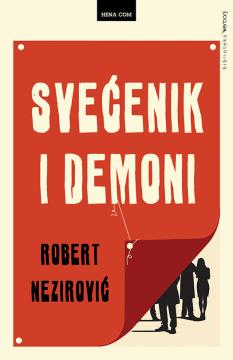
Svećenik i demoni

Svećenik i demoni

Robert Nezirović

When a police inspector receives news of the brutal murder of a priest, and then goes out into the field and finds a bracelet with an engraved name, one has no choice but to think that we are at the beginning of an intriguing crime story.

But just as some names can be both female and male, some novels are not what they appear to be at the first sentence. Robert Nezirović's novel is energetic and dynamic, as the genre requires, but who brought it is not in the foreground here, although, don't worry, you will find out in the end.

A successful neurosurgeon, a politician on a downward trajectory, a representative of Zagreb's underground and an architect once sat together in the school desks of the coastal city, and now, each of them from their complicated lives, will briefly go to the funeral of a schoolmate, a murdered priest. While the investigation is going on in the background, each of the characters, including the inspector who leads it, struggles with their private and professional setbacks, and the intertwining of their stories opens up numerous neuralgic themes of turbulent reality. And while one bracelet is looking for its owner, pieces of the well-known bilge are torn from the whirlwind of the characters' lives - the combination of politics and the mafia, political turbulence, homophobia, drugs and prostitution - along with marital shipwrecks, illnesses, loneliness, and even an obsession with a pop star.

Through the destinies of the characters, Nezirović scans various layers of society, and in this one can clearly feel the criticism towards deviations, immorality, and corruption. The characters are not just figures that depict society, but are carefully characterized with their inner and outer demons that come to light when we least expect it.

Editor
Jagna Pogačnik, Nermina Husković
Graphics design
Jasna Goreta
Dimensions
21.5 x 14 cm
Pages
239
Publisher
Hena Com, Zagreb, 2023.
 
Latin alphabet. Hardcover with dust jacket.
Language: Croatian.
ISBN
978-9-53259-456-0

One copy is available

Condition:Unused
 

Are you interested in another book? You can search the offer using our search engine or browse books by category.

You may also be interested in these titles

Knjiga moga oca

Knjiga moga oca

Ethem Mandić

This is a biography about my father made up of memories and mere imagination. History does not exist, and neither do facts. The past is unknown.

OKF d.o.o, 2016.
Croatian. Latin alphabet. Paperback.
10.649.58
Proces

Proces

Franz Kafka

Kafka je napisao Proces između 1914. i 1915., objavljen posthumno 1925. godine. Roman je nedovršen ali s dodanim završnim poglavljem od Maxa Broda. Izdanje s predgovorom B. Živojinovića i pogovorom Waltera Killija.

BIGZ, 1990.
Serbian. Latin alphabet. Paperback.
4.26
Zvezde su tamne

Zvezde su tamne

Peter Cheyney

"Zvezde su tamne" je špijunski triler britanskog pisca Petera Cheyneyja, poznatog po brzim, napetim pričama i tvrdokuhanim likovima.

Svjetlost, 1965.
Serbian. Latin alphabet. Paperback.
2.96
I ne reče ni reči

I ne reče ni reči

Heinrich Böll

U Bollovim romanima jedna od središnjih tema je pokušaj da se očuvaju osnovne moralne vrijednosti u vrijeme terora, kao i u razdoblju materijalnog blagostanja i korupcije.

Svjetlost, 1965.
Serbian. Latin alphabet. Paperback.
3.22 - 3.98
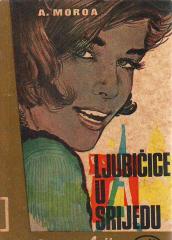
Ljubičice u srijedu

Ljubičice u srijedu

Andre Maurois

André Maurois, a French writer known for his psychological novels and biographies, explores themes of family relationships, love, and internal conflicts in this work, which is characteristic of his style.

Svjetlost, 1965.
Croatian. Latin alphabet. Paperback.
3.42 - 3.62
Gradić gdje je vrijeme stalo

Gradić gdje je vrijeme stalo

Bohumil Hrabal

Bohumil Hrabal, a Czech writer known for his lyrical grotesque and humor, in his novel The Town Where Time Stood Still evokes childhood in the small town of Libeň (part of Prague), where time seems to stand still in a magical but melancholic world.

Hena Com, 2006.
Croatian. Latin alphabet. Paperback.
7.626.10