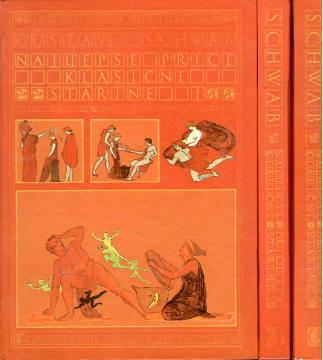
Najljepše priče klasične starine

Najljepše priče klasične starine

Gustav Schwab

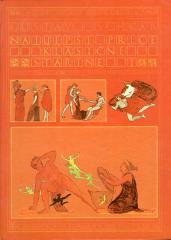
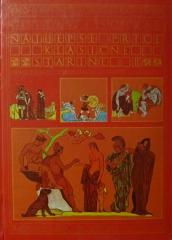
Schwab's work restores and develops a sense of the value of antiquity, that inexhaustible source of folk fantasy that seeks to interpret and explain the world with the original poetic power recognized in the traditions of ancient man.

Greek myths especially marked the very basis of the entire Western culture, they have diverse motifs and great poetic beauty. Olympian, underground and sea gods, lower deities, and heroes who are of divine origin by father or mother, are the main heroes of these mythical stories. The most famous are Prometheus, Heracles, Theseus, Dioscuri, Jason, Perseus, Achilles, Melagar, and many others who carry out often difficult and dangerous tasks assigned to them by the gods or customs inherited from the gods. Schwab covers larger mythological cycles, such as the Trojan War, but there are also the famous heroes Daedalus and Icarus, the Argonauts, Orpheus and Eurydice, Antigone and many others.

Original title
Die schonsten sagen des klassischen altertums
Translation
Stjepan Hosu
Editor
Branko Matan
Illustrations
John Flaxman, Asmus J. Carstens, Ed. Schuler, C. Bartling
Graphics design
Zoran Pavlović
Dimensions
24 x 17 cm
 
The book consists of 3 volumes.
Pages total
804
Publisher
Grafički zavod Hrvatske (GZH), Zagreb, 1989.
 
Latin alphabet. Hardcover.
Language: Croatian.

No copies available

The last copy was sold recently.


Are you interested in another book? You can search the offer using our search engine or browse books by category.

You may also be interested in these titles

Najljepše priče klasične starine

Najljepše priče klasične starine

Gustav Schwab
Mladost, 1972.
Croatian. Latin alphabet. Hardcover.
7.22
Najljepše priče klasične starine 1-2

Najljepše priče klasične starine 1-2

Gustav Schwab

Schwab's work renews and develops a sense of the value of antiquity, that inexhaustible source of folk fantasy that seeks to interpret and explain the world with original poetic power.

CID-NOVA, 1995.
Croatian. Latin alphabet. Hardcover.
The book consists of two volumes
19.42
Svi će ljudi biti braća

Svi će ljudi biti braća

Johannes Mario Simmel

The novel explores the moral dilemmas and social contradictions of post-war Europe. Through a tense crime story, the novel follows the protagonist as he faces personal and political challenges, revealing the complex relationships between the individual an

Mladost, 1984.
Croatian. Latin alphabet. Hardcover with dust jacket.
The book consists of two volumes
8.54
Kralj petroleja

Kralj petroleja

Karl May

The Oil Prince is a story by Karl May that he wrote for the magazine Der Gute Kamerad between August 1892 and the beginning of 1893. The story of the same name, Der Oelprinz, which was published in 1878, is not a precursor to this famous youth story.

Mladost, 1965.
Croatian. Latin alphabet. Hardcover with dust jacket.
4.96 - 4.98
Tako je govorio Zaratustra

Tako je govorio Zaratustra

Friedrich Nietzsche

A philosophical novel that presents the key ideas of Nietzsche's philosophy through a poetic and allegorical style. Zarathustra, a character inspired by an ancient Persian prophet, descends from a mountain after ten years of solitude to share his wisdom w

Mladost, 1983.
Croatian. Latin alphabet. Hardcover with dust jacket.
26.52
Josip i njegova braća II: Mladi Josip

Josip i njegova braća II: Mladi Josip

Thomas Mann

The second part of the tetralogy by German Nobel Prize winner Thomas Mann, Joseph and His Brothers, is entitled Young Joseph. This tetralogy is considered one of the most important works by Thomas Mann, as well as by German literature of the twentieth cen

Fraktura, 2009.
Croatian. Latin alphabet. Hardcover with dust jacket.
27.34