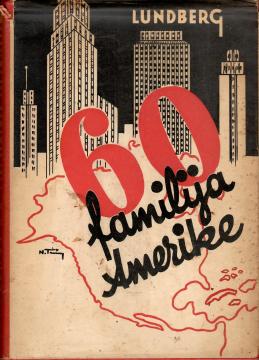
60 familija Amerike
Antique
Rare book

60 familija Amerike

Ferdinand Lundberg

This pioneering work by Lundberg explores the economic and political influence of the wealthiest and most powerful families in the United States during the first half of the 20th century.

Lundberg argued that those 60 families control the vast majority of the country's wealth and use their influence to shape policy, economic decisions and social trends to their advantage. His analysis was a pioneering attempt to highlight inequality in wealth and power, and to explore the ways in which this concentration of power affects democracy and freedom.

Lundberg argued that the American economy is not driven by the free market, but by the interests of these wealthy families. According to his research, these families used their money to manipulate the political process, including financing campaigns and influencing legislative decisions.

Analyzing financial data, the author pointed to huge differences in wealth between the richest and average Americans. Lundberg explored the connection between the big banks, corporations and the political system, which were controlled by these families.

Although the book was written almost a century ago, many believe that the themes covered by Lundberg are still relevant, given that questions about the concentration of wealth and power remain relevant in modern society.

Editor
A. D. Batrinski
Dimensions
21 x 15 cm
Pages
222
Publisher
Epoha, Zagreb, 1940.
 
Latin alphabet. Hardcover with dust jacket.
Language: Croatian.

No copies available

The last copy was sold recently.
 

Are you interested in another book? You can search the offer using our search engine or browse books by category.

You may also be interested in these titles

Zbogom oružje

Zbogom oružje

Ernest Hemingway

Hemingway's novel A Farewell to Arms (1929), set on the Italo-Austrian front, follows the love story and wartime experiences of Frederic Henry, an American lieutenant who serves as an ambulance driver in the Italian army during World War I.

Mladost, 1952.
Croatian. Latin alphabet. Paperback.
1.00 - 6.50
Zovem se Aram

Zovem se Aram

William Saroyan

Aram, a boy growing up in an Armenian-American family in California, tells a story of childhood, poverty, and family values ​​through humor and warmth, revealing the beauty of ordinary life and the power of togetherness.

Džepna knjiga, 1956.
Croatian. Latin alphabet. Paperback.
4.12
Ko je ubio Verna Vuda?

Ko je ubio Verna Vuda?

John Resse
Forum, 1987.
Serbian. Latin alphabet. Paperback.
3.50
Doživljaji Huckleberryja Finna

Doživljaji Huckleberryja Finna

Mark Twain
Školska knjiga, 1982.
Croatian. Latin alphabet. Paperback.
1.00 - 2.50
Nasljeđe pustinje

Nasljeđe pustinje

Zane Grey

Grey's most poetic work – an ode to the red desert, love, and spiritual awakening.

Otokar Keršovani, 1966.
Croatian. Latin alphabet. Paperback.
3.20 - 3.48
Skrupule

Skrupule

Judith Krantz
Mladinska knjiga, 1990.
Croatian. Latin alphabet. Hardcover with dust jacket.
6.64