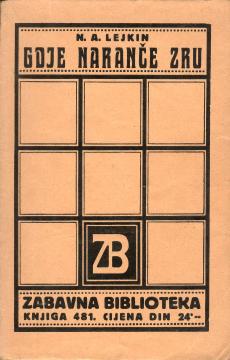
Gdje naranče zru: humoristički roman iz starih vremena, u kojem se opisuje putovanje Nikolaja Ivanovića i Glafire Semjonovne Ivanovih s trgovačkim drugom Ivanom Kondratjevićem Konurinim, po krajevima, gdje "naranče zru"
Rare book
Antique

Gdje naranče zru: humoristički roman iz starih vremena, u kojem se opisuje putovanje Nikolaja Ivanovića i Glafire Semjonovne Ivanovih s trgovačkim drugom Ivanom Kondratjevićem Konurinim, po krajevima, gdje "naranče zru"

Nikolaj A. Lejkin

"Where the oranges ripen" is a novel that causes laughter, but there is also a noticeable note of satire in it.

In the novel "Where Oranges Ripe", the experiences of three Russian tourists on a trip through southern France and Italy are humorously and cheerfully told. The novel's characters get into a series of comical situations that still seem original and fresh today. Their stay in Nice, Monte Carlo, Rome and Naples is a refined mockery of snobbery, skorojevics and lack of culture.

Original title
Gdě apel'siny zrějut
Translation
Nikola Nikolajević
Editor
Nikola Andrić
Dimensions
20 x 13 cm
Pages
207
Publisher
Naklada zaklade tiskare Narodnih novina, Zagreb, 1930.
 
Latin alphabet. Paperback.
Language: Croatian.

No copies available

The last copy was sold recently.
 

Are you interested in another book? You can search the offer using our search engine or browse books by category.

You may also be interested in these titles

Uzorana ledina

Uzorana ledina

Mihail Šolohov

The novel is set in a Cossack community on the Don River during collectivization in the Soviet Union. The work, divided into two parts, follows the dramatic changes in the village of Gremyachi Log as the Bolsheviks introduce collective farms, which provok

Sveučilišna naklada Liber (SNL), 1980.
Croatian. Latin alphabet. Hardcover with dust jacket.
8.32
Djetinjstvo

Djetinjstvo

Lav Nikolajevič Tolstoj

Childhood (1852) is the first book of an autobiographical trilogy (with Adolescence and Youth), where Tolstoy explores the world of childhood through the eyes of a ten-year-old boy, Nikolinka Irtenjev – innocence, joys, sorrows and first traumas.

Svjetlost, 1971.
Croatian. Latin alphabet. Hardcover.
6.54
Zlatno tele

Zlatno tele

Ilja Iljf, Jevgenij Petrov

The Golden Calf (1931) is a brilliant satirical picaresque adventure, a sequel to the legendary 12 Chairs, where the great schemer Ostap Bender returns in full glory – charming, cynical, irredeemably cunning and always one step ahead of everyone else.

Kultura, 1946.
Croatian. Latin alphabet. Hardcover with dust jacket.
7.56
Poziv na pogubljenje

Poziv na pogubljenje

Vladimir Nabokov

There is no doubt that it is most attractive to read The Call to Execution as it appears to be written, as an anti-utopian or anti-totalitarian novel...

Nolit, 1988.
Serbian. Latin alphabet. Hardcover with dust jacket.
12.32
Zlatno telešce

Zlatno telešce

Ilja Iljf, Evgenij Petrov

The Golden Calf (1931) follows the ingenious con artist Ostap Bender, who in Soviet Russia during the first five-year plan seeks a secret millionaire in order to get rich, encountering the absurdity of bureaucracy, the new Soviet man, and his own downfall

Naklada Binoza, 1934.
Croatian. Latin alphabet. Hardcover with dust jacket.
9.74
Sabrana djela A. P. Čehova #4: Dan izvan grada

Sabrana djela A. P. Čehova #4: Dan izvan grada

Anton Pavlovič Čehov

The fourth volume of Chekhov's works contains novellas and humoresques, which were mostly written in 1886. Still writing for a fee in daily newspapers, Chekhov often had to subordinate his art to comprehensibility and cheap humor due to the taste of the r

Zora, 1959.
Croatian. Latin alphabet. Hardcover with dust jacket.
9.56