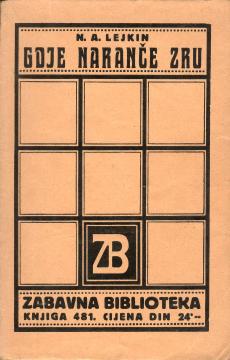
Gdje naranče zru: humoristički roman iz starih vremena, u kojem se opisuje putovanje Nikolaja Ivanovića i Glafire Semjonovne Ivanovih s trgovačkim drugom Ivanom Kondratjevićem Konurinim, po krajevima, gdje "naranče zru"
Rare book
Antique

Gdje naranče zru: humoristički roman iz starih vremena, u kojem se opisuje putovanje Nikolaja Ivanovića i Glafire Semjonovne Ivanovih s trgovačkim drugom Ivanom Kondratjevićem Konurinim, po krajevima, gdje "naranče zru"

Nikolaj A. Lejkin

"Where the oranges ripen" is a novel that causes laughter, but there is also a noticeable note of satire in it.

In the novel "Where Oranges Ripe", the experiences of three Russian tourists on a trip through southern France and Italy are humorously and cheerfully told. The novel's characters get into a series of comical situations that still seem original and fresh today. Their stay in Nice, Monte Carlo, Rome and Naples is a refined mockery of snobbery, skorojevics and lack of culture.

Original title
Gdě apel'siny zrějut
Translation
Nikola Nikolajević
Editor
Nikola Andrić
Dimensions
20 x 13 cm
Pages
207
Publisher
Naklada zaklade tiskare Narodnih novina, Zagreb, 1930.
 
Latin alphabet. Paperback.
Language: Croatian.

No copies available

The last copy was sold recently.
 

Are you interested in another book? You can search the offer using our search engine or browse books by category.

You may also be interested in these titles

Moskva – Petuški

Moskva – Petuški

Venjedikt Jerofejev

Venedikt Yerofeyev's postmodern prose poem is today considered a classic of new Russian literature. It is compared to Gogol and Kharms for its poetics of absurdity, satire, and metaphysical depth.

LOM, 217.
Serbian. Cyrillic alphabet. Paperback.
11.24
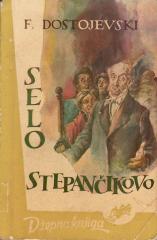
Selo Stepančikovo

Selo Stepančikovo

Fjodor Mihajlovič Dostojevski

"The Village of Stepanchikovo" is a humorous novel by Dostoyevsky, first published in 1859. This novel, which differs from the later, darker works of the author, is a satirical critique of social relations and human weaknesses.

Svjetlost, 1962.
Serbian. Latin alphabet. Paperback.
4.22 - 4.76
Djetinjstvo

Djetinjstvo

Lav Nikolajevič Tolstoj

Childhood (1852) is the first book of an autobiographical trilogy (with Adolescence and Youth), where Tolstoy explores the world of childhood through the eyes of a ten-year-old boy, Nikolinka Irtenjev – innocence, joys, sorrows and first traumas.

Svjetlost, 1971.
Croatian. Latin alphabet. Hardcover.
6.54
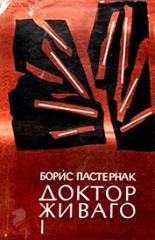
Doktor Živago 1-2

Doktor Živago 1-2

Boris Pasternak

One of the most significant works of 20th-century Russian literature, the novel follows the life of Yuri Zhivago, a physician and poet, through the dramatic events of World War I, the October Revolution, and the Russian Civil War.

Prosveta, 1962.
Serbian. Cyrillic alphabet. Hardcover with dust jacket.
The book consists of two volumes
5.32
Zlatno tele

Zlatno tele

Ilja Iljf, Jevgenij Petrov

The Golden Calf (1931) is a brilliant satirical picaresque adventure, a sequel to the legendary 12 Chairs, where the great schemer Ostap Bender returns in full glory – charming, cynical, irredeemably cunning and always one step ahead of everyone else.

Kultura, 1946.
Croatian. Latin alphabet. Hardcover with dust jacket.
7.56
Roman s kokainom

Roman s kokainom

Mihail Agejev

A novel with cocaine is a psychological prose in which the narrator Vadim Maslenikov presents his "case" of moral and physical decay during the turbulent years of Russian history. Mihail Ageyev is the pseudonym of Mark Levi.

Gradac, 1987.
Serbian. Latin alphabet. Paperback with dust jacket.
8.24